Published on Wednesday, November 22, 2006 by the Los Angeles Times
Naysayers who argue that climate change is unsolvable because of 'human nature' ignore how past crises were averted.
by Julia Whitty
What if 12 asteroids were on collision courses with Earth? What if we could alter their trajectories and save our planet by the cumulative effect of our individual efforts? What if science and history proved that we were fully capable of such heroism? What would it take to get us started?
John Schellnhuber, distinguished science advisor at the Tyndall Center for Climate Change Research in Britain, has identified 12 global warming tipping points, such as the deforestation of the Amazon rain forest or the melting of the west Antarctic ice sheet. Any of these, if triggered, would probably initiate sudden changes across the planet as cataclysmic as any asteroid strike.
So what will it take to trigger what we might call the 13th tipping point, the shift from personal denial to personal responsibility? What will tip us toward addressing global warming with the urgency it deserves, as the mother of all threats to homeland security?
A 2005 study on Americans' perceptions of global warming found that most are moderately concerned, but 68% believe that the greatest threats are to people far away or to nonhuman nature — a dangerous and delusional misperception. Only 13% perceive risk to themselves, their families or their communities.
Many secretly perceive global warming to be an insoluble problem and respond by circling the family wagons and turning inward. Yet human beings are born with powerful tools for solving this quandary. We have the genetic smarts and the cultural smarts. We have the technological know-how. We even have the inclination.
The truth is, we can change ourselves with breathtaking speed, sculpting even "immutable" human nature. Forty years ago, many believed human nature mandated that blacks and whites live in segregation; 30 years ago human nature divided men and women into separate economies; 20 years ago human nature prevented us from defusing a global nuclear standoff. Nowadays we blame human nature for the insolvable hazards of global warming.
Research out of the Max Planck Institute in Germany suggests how we might help ourselves evolve. Using a variation on game theory, researchers found that almost no one would donate money anonymously, but that the few who did were the ones who knew most about the issue at hand. So we would be inclined to behave as better environmental citizens when we are educated and our individual actions are visible to those around us — a phenomenon known as "social facilitation."
Perhaps if we're vigorously informed about how global warming endangers our neighborhoods, we'll individually forgo the McMansions and the Hummers and make sustainable choices. Anything less compromises our children's future.
Until then, our denial facilitates "social loafing" — the tendency of individuals to slack when work is shared and individual performance is not assessed. There's no better example than Congress, where members cloak their lethargy regarding global warming behind the stultifying inactivity of their fellows. And why not? After all, who's watching?
Not the media, which habitually squelch new science stories on global warming by rationalizing that we've heard that before — though they would never ignore another round of Middle East bloodletting. The growing body of scientific knowledge on climate change gains heft and power as it accumulates, but the public rarely hears about it, reinforcing our loafing.
Scientists don't help when they react to the terrifying dimensions of public ignorance by sheltering inside hallowed halls. At a recent meeting of the Society for Conservation Biology, 70% of members argued in favor of advocating real solutions to environmental problems directly to lethargic policymakers and the media. Yet very few have stepped out into the public arena at a time when we need their knowledge and expertise as never before.
The nature of tipping points is that they happen dizzyingly fast. The good news is that history proves we're capable of keeping up. Social scientists once believed that it would take decades of government pressure and education for Americans to choose smaller families because the desire to procreate is an absolute part of the human animal, or so they thought. Yet population growth radically declined over only three years in the 1970s — one woman at a time, without an ounce of government involvement.
Political leaders can help. But even without them we can help ourselves. When President Bush says we can't act on global warming until we "fully understand the nature of the problem," we can use his callous disregard as a rallying cry.
The truth is, humans can change, and change fast. Our hallmark is adaptability. Long ago, we looked out from the trees and saw the savannas. Beyond the savannas we glimpsed further frontiers. History proves that when we behold a better world, we move toward it — one person at a time — leaving behind what no longer works.
We know what to do. We know how to do it. We know the timeline. We are our own tipping point.
28 November 2006
27 November 2006
Winds of Change
Energy Firms Come to Terms With Climate Change
By Steven Mufson and Juliet Eilperin
Washington Post Staff Writers
Saturday, November 25, 2006; Page A01
While the political debate over global warming continues, top executives at many of the nation's largest energy companies have accepted the scientific consensus about climate change and see federal regulation to cut greenhouse gas emissions as inevitable.
The Democratic takeover of Congress makes it more likely that the federal government will attempt to regulate emissions. The companies have been hiring new lobbyists who they hope can help fashion a national approach that would avert a patchwork of state plans now in the works. They are also working to change some company practices in anticipation of the regulation.
"We have to deal with greenhouse gases," John Hofmeister, president of Shell Oil Co., said in a recent speech at the National Press Club. "From Shell's point of view, the debate is over. When 98 percent of scientists agree, who is Shell to say, 'Let's debate the science'?"
Hofmeister and other top energy company leaders, such as Duke Energy Corp.'s chief executive, James E. Rogers, back a proposal that would cap greenhouse gas emissions and allow firms to trade their quotas.
Paul M. Anderson, Duke Energy's chairman and a member of the president's Council of Advisors on Science and Technology, favors a tax on emissions of carbon dioxide, the most prevalent greenhouse gas. His firm is the nation's third-largest burner of coal.
Exxon Mobil Corp., the highest-profile corporate skeptic about global warming, said in September that it was considering ending its funding of a think tank that has sought to cast doubts on climate change. And on Nov. 2, the company announced that it will contribute more than $1.25 million to a European Union study on how to store carbon dioxide in natural gas fields in the Norwegian North Sea, Algeria and Germany.
These changes come as Democratic leaders prepare to take over key committees on Capitol Hill. Sen. Barbara Boxer (Calif.), who calls global warming "the greatest challenge of our generation," will take the place of Sen. James M. Inhofe (R-Okla.) as chairman of the Senate Environment and Public Works Committee. Inhofe refers to global warming as a "hoax."
Sen. Jeff Bingaman (D-N.M.), the incoming Energy and Natural Resources Committee chairman, said he hopes to "do something on global warming." Even though the Bush administration's expected opposition might make the enactment of legislation unlikely in the next two years, many companies cannot put off decisions about what sort of power plants to build.
Duke Energy, for example, has not added significant power generation in two decades, and customer demand is rising 1 to 2 percent a year. The company has included a price for the carbon emitted in its cost estimates for a new coal-fired generating plant proposed for Indiana.
"If we had our druthers, we'd already have carbon legislation passed," said John L. Stowell, Duke Energy's vice president for environmental policy. "Our viewpoint is that it's going to happen. There's scientific evidence of climate change. We'd like to know what legislation will be put together so that, when we figure out how to increase our load, we know exactly what to expect."
One reason companies are turning to Congress is to avert the multiplicity of regulations being drafted by various state governments. The Regional Greenhouse Gas Initiative, a group of seven Northeastern states, is moving ahead with a proposed system that would set a ceiling on greenhouse gas emissions, issue allowances to companies, and allow firms to trade those allowances to comply with regulations.
California is drawing up its program. Other states are also contemplating limits. Even the city of Boulder, Colo., has adopted its own plan -- a carbon tax based on electricity use.
"We cannot deal with 50 different policies," said Shell's Hofmeister. "We need a national approach to greenhouse gases."
Next week, the Supreme Court will hear arguments on whether the federal government is obligated to regulate carbon dioxide as a pollutant; its decision could force the government to come up with guidelines.
Though many energy firms had already voiced support in recent months for federal regulations limiting greenhouse gas emissions, the coming changeover in Congress has intensified the discussions.
"There have been many more folks wanting to engage on the detailed architecture of climate-change legislation," said Jason S. Grumet, executive director of the bipartisan National Commission on Energy Policy. "The tenor, tone and the detail of discussions has changed in the last couple of months. Nobody's going to want to be the last company to come before the Congress and say, 'I've been opposing you for five years, but now can I have my piece?' "
Some businesses are making new hires based on the assumption that legislative activity on global warming will increase in the coming months. Truman Semans, director of markets and business strategy for the Pew Center on Global Climate Change, said at least half a dozen of the companies that belong to the center's Business Environmental Leadership Council have recently hired staff members focused on global warming.
Not every energy company is planning to curb greenhouse gas emissions in the near future. TXU Corp. is planning to spend $10 billion to build 11 new coal-fired power plants, which would more than double the company's carbon dioxide emissions, from 55 million tons to 133 million tons a year. That increase in emissions is more than the total carbon dioxide pollution emitted in all of Maryland or by 10 million Cadillac Escalade sport-utility vehicles.
In an e-mail to The Washington Post, TXU spokeswoman Kimberly Morgan said that the company supports "a comprehensive, voluntary, technology-based approach to global climate change based on carbon intensity" that is both "flexible and cost effective."
"We are at a point in time where other states and businesses are starting to take global warming seriously," said Colin Rowan, spokesman for the advocacy group Environmental Defense. "California is heading toward the future, and TXU and Texas are sprinting full speed back to the 1950s."
The company's approach may pay off in the short term, but it may not last. "Over the next two years I don't think environmental policy is going to change radically," said Carl Pope, executive director of the advocacy group Sierra Club. But he added, "I think the environmental agenda and conversation will change radically."
Corporate America wants to be part of that conversation. Duke Energy's Stowell said: "Industry is coming together and saying, 'Okay, if we're going to do this, let's do this in a way that won't wreck the economy.' "
The American Supreme Court interpretation of the EPA's span of control next week might be one of the most important environmental considerations seen on this level since the 1970s. Maybe there is some hope that the corporations are going to listen to public sentiment and work with the federal governments' departments to illicit positive changes to policy, economic systems, and mindsets to address the concerns of unregulated CO2 emissions. The key for this to move forward globally has been to get the American corporate and political leaders to see the urgency in the issue. I can't see why this has taken so long, given the American dependency on foreign energy sources. As an issue of national security, you would think conversations on conservation and controls would have been on the table a long time ago. But then, consumption orgies tend to make people think and justify their behaviors in odd, irrational ways.
US and China a world apart on oil policy
As the world's top two oil guzzlers, the US and China should have lots in common when it comes to energy policy. But US experts see a difference in how the two countries view energy security, one that could undermine economic co-operation as the global titans vie for limited oil supplies in the future. To US politicians, including President George W. Bush, it means cutting US import dependence by promoting home-grown fuels such as ethanol, and reducing the risk of price shocks by relying on a variety of sources and suppliers. To Beijing, it means locking up secure supplies in multi-billion-dollar deals, such as the ones cut in recent years in Venezuela and Canada, US officials say. More recently, China has sought closer economic ties with Saudi Arabia, which has shared an oil-for-security relationship with Washington for decades. It has also actively sought long-term supply guarantees with Saudi Arabia and other Middle East producers as it seeks oil to fuel future economic growth. Karen Harbert, assistant secretary for policy and international affairs at the US Energy Department, said the US and China "still have a ways to go" in finding common ground. "It is certainly clear at this point in time that we define energy security differently," Harbert said. "We define it as having a supply of reliable, affordable energy, and they define it as having secure access and owning access to that product," she said. US officials have met frequently with Chinese counterparts to stress their belief in the importance of allowing the market to set global energy prices. And China's rising oil use will be centre-stage when US officials, including Energy Secretary Sam Bodman and Treasury Secretary Henry Paulson, visit Beijing in December, when they will seek a common energy market vision.
(National Post 061128)
I wonder which of the US and China is going to be the first to send off the ICBMs when the oil wars truly get traction? Do you notice how since conservation is a concept that is at odds with the unending growth model of free capitalism, it is never discussed as a part of the solution of relieving foreign dependence on oil? It is probably one of the easiest to implement (ie., a bit of education), however the one furthest from anyone's minds.
Kremlin grip on gas supply stokes unease
For the West, the threat from Moscow was supposed to end with the collapse of the Soviet Union 15 years ago. But Russia's growing energy clout is generating renewed cause for anxiety. The North Atlantic Treaty Organization, set up in the early days of the Cold War to keep Soviet-led forces in check, has begun speaking out about the potent new energy lever being wielded by the Kremlin in the international struggle for influence. NATO Secretary-General Jaap de Hoop Scheffer says energy security will be high on the agenda at its summit starting today in Riga, Latvia. He notes there was “added value to NATO discussing energy and security policies.” The main issue is natural gas. Russia is an oil giant, second only to the Saudis in exports, and Europe depends on it for a quarter of the crude it consumes. But oil supplies can be diversified because shipping is easy, while the most efficient way of distributing gas is through pipelines. With Russia as the world's largest gas exporter and Europe's neighbour, European dependency has grown to the point that the EU now counts on Moscow for nearly half of its gas needs. And Moscow's control of pipelines that deliver not only gas from Russia but from much of central Asia is stoking Western unease. “With gas, control over pipelines is crucial,” says energy expert Michael Klare. “Once you put oil on a tanker, you cannot control it, but gas is different; whoever controls the pipelines controls the flow.”
A study conducted earlier this year for the Swedish Defense Research Agency concludes that Russia uses its growing energy punch to “extend influence, avert geopolitical and macroeconomic threats and to reduce the risk of being blackmailed.” Moscow insists market forces are driving its price policy. But its allies, like Armenia, pay much less than its critics, like Georgia. The Swedish study notes more than 50 cases since 1991 where the Russian “energy lever has been used for putting political or economic pressure on Estonia, Latvia, Lithuania, Ukraine, Belarus, Moldova (and) Georgia.” Other surveys also draw worrying conclusions. A recently leaked confidential study by NATO economic experts warned that Russia may be seeking to build a gas cartel including Algeria, Qatar, Libya, the countries of central Asia and perhaps Iran and said that kind of OPEC-like near monopoly would strengthen Moscow's leverage over Europe. Russian Finance Minister Alexei Kudrin this month denied that Russia was planning on building a cartel, however.
(Globe and Mail 061128)
Ahh, the 1990s. The last time there was a capacity cushion in the world oil and gas supply, probably for ever. Be prepared for bigger and bigger fluctuations in what you pay for O & G in the coming years, as now exporters will have a lot more clout on price establishment, and with no cushion, any disruptions to O & G production or transmission will have a ripple effect on global prices. Strange times, indeed.
By Steven Mufson and Juliet Eilperin
Washington Post Staff Writers
Saturday, November 25, 2006; Page A01
While the political debate over global warming continues, top executives at many of the nation's largest energy companies have accepted the scientific consensus about climate change and see federal regulation to cut greenhouse gas emissions as inevitable.
The Democratic takeover of Congress makes it more likely that the federal government will attempt to regulate emissions. The companies have been hiring new lobbyists who they hope can help fashion a national approach that would avert a patchwork of state plans now in the works. They are also working to change some company practices in anticipation of the regulation.
"We have to deal with greenhouse gases," John Hofmeister, president of Shell Oil Co., said in a recent speech at the National Press Club. "From Shell's point of view, the debate is over. When 98 percent of scientists agree, who is Shell to say, 'Let's debate the science'?"
Hofmeister and other top energy company leaders, such as Duke Energy Corp.'s chief executive, James E. Rogers, back a proposal that would cap greenhouse gas emissions and allow firms to trade their quotas.
Paul M. Anderson, Duke Energy's chairman and a member of the president's Council of Advisors on Science and Technology, favors a tax on emissions of carbon dioxide, the most prevalent greenhouse gas. His firm is the nation's third-largest burner of coal.
Exxon Mobil Corp., the highest-profile corporate skeptic about global warming, said in September that it was considering ending its funding of a think tank that has sought to cast doubts on climate change. And on Nov. 2, the company announced that it will contribute more than $1.25 million to a European Union study on how to store carbon dioxide in natural gas fields in the Norwegian North Sea, Algeria and Germany.
These changes come as Democratic leaders prepare to take over key committees on Capitol Hill. Sen. Barbara Boxer (Calif.), who calls global warming "the greatest challenge of our generation," will take the place of Sen. James M. Inhofe (R-Okla.) as chairman of the Senate Environment and Public Works Committee. Inhofe refers to global warming as a "hoax."
Sen. Jeff Bingaman (D-N.M.), the incoming Energy and Natural Resources Committee chairman, said he hopes to "do something on global warming." Even though the Bush administration's expected opposition might make the enactment of legislation unlikely in the next two years, many companies cannot put off decisions about what sort of power plants to build.
Duke Energy, for example, has not added significant power generation in two decades, and customer demand is rising 1 to 2 percent a year. The company has included a price for the carbon emitted in its cost estimates for a new coal-fired generating plant proposed for Indiana.
"If we had our druthers, we'd already have carbon legislation passed," said John L. Stowell, Duke Energy's vice president for environmental policy. "Our viewpoint is that it's going to happen. There's scientific evidence of climate change. We'd like to know what legislation will be put together so that, when we figure out how to increase our load, we know exactly what to expect."
One reason companies are turning to Congress is to avert the multiplicity of regulations being drafted by various state governments. The Regional Greenhouse Gas Initiative, a group of seven Northeastern states, is moving ahead with a proposed system that would set a ceiling on greenhouse gas emissions, issue allowances to companies, and allow firms to trade those allowances to comply with regulations.
California is drawing up its program. Other states are also contemplating limits. Even the city of Boulder, Colo., has adopted its own plan -- a carbon tax based on electricity use.
"We cannot deal with 50 different policies," said Shell's Hofmeister. "We need a national approach to greenhouse gases."
Next week, the Supreme Court will hear arguments on whether the federal government is obligated to regulate carbon dioxide as a pollutant; its decision could force the government to come up with guidelines.
Though many energy firms had already voiced support in recent months for federal regulations limiting greenhouse gas emissions, the coming changeover in Congress has intensified the discussions.
"There have been many more folks wanting to engage on the detailed architecture of climate-change legislation," said Jason S. Grumet, executive director of the bipartisan National Commission on Energy Policy. "The tenor, tone and the detail of discussions has changed in the last couple of months. Nobody's going to want to be the last company to come before the Congress and say, 'I've been opposing you for five years, but now can I have my piece?' "
Some businesses are making new hires based on the assumption that legislative activity on global warming will increase in the coming months. Truman Semans, director of markets and business strategy for the Pew Center on Global Climate Change, said at least half a dozen of the companies that belong to the center's Business Environmental Leadership Council have recently hired staff members focused on global warming.
Not every energy company is planning to curb greenhouse gas emissions in the near future. TXU Corp. is planning to spend $10 billion to build 11 new coal-fired power plants, which would more than double the company's carbon dioxide emissions, from 55 million tons to 133 million tons a year. That increase in emissions is more than the total carbon dioxide pollution emitted in all of Maryland or by 10 million Cadillac Escalade sport-utility vehicles.
In an e-mail to The Washington Post, TXU spokeswoman Kimberly Morgan said that the company supports "a comprehensive, voluntary, technology-based approach to global climate change based on carbon intensity" that is both "flexible and cost effective."
"We are at a point in time where other states and businesses are starting to take global warming seriously," said Colin Rowan, spokesman for the advocacy group Environmental Defense. "California is heading toward the future, and TXU and Texas are sprinting full speed back to the 1950s."
The company's approach may pay off in the short term, but it may not last. "Over the next two years I don't think environmental policy is going to change radically," said Carl Pope, executive director of the advocacy group Sierra Club. But he added, "I think the environmental agenda and conversation will change radically."
Corporate America wants to be part of that conversation. Duke Energy's Stowell said: "Industry is coming together and saying, 'Okay, if we're going to do this, let's do this in a way that won't wreck the economy.' "
The American Supreme Court interpretation of the EPA's span of control next week might be one of the most important environmental considerations seen on this level since the 1970s. Maybe there is some hope that the corporations are going to listen to public sentiment and work with the federal governments' departments to illicit positive changes to policy, economic systems, and mindsets to address the concerns of unregulated CO2 emissions. The key for this to move forward globally has been to get the American corporate and political leaders to see the urgency in the issue. I can't see why this has taken so long, given the American dependency on foreign energy sources. As an issue of national security, you would think conversations on conservation and controls would have been on the table a long time ago. But then, consumption orgies tend to make people think and justify their behaviors in odd, irrational ways.
US and China a world apart on oil policy
As the world's top two oil guzzlers, the US and China should have lots in common when it comes to energy policy. But US experts see a difference in how the two countries view energy security, one that could undermine economic co-operation as the global titans vie for limited oil supplies in the future. To US politicians, including President George W. Bush, it means cutting US import dependence by promoting home-grown fuels such as ethanol, and reducing the risk of price shocks by relying on a variety of sources and suppliers. To Beijing, it means locking up secure supplies in multi-billion-dollar deals, such as the ones cut in recent years in Venezuela and Canada, US officials say. More recently, China has sought closer economic ties with Saudi Arabia, which has shared an oil-for-security relationship with Washington for decades. It has also actively sought long-term supply guarantees with Saudi Arabia and other Middle East producers as it seeks oil to fuel future economic growth. Karen Harbert, assistant secretary for policy and international affairs at the US Energy Department, said the US and China "still have a ways to go" in finding common ground. "It is certainly clear at this point in time that we define energy security differently," Harbert said. "We define it as having a supply of reliable, affordable energy, and they define it as having secure access and owning access to that product," she said. US officials have met frequently with Chinese counterparts to stress their belief in the importance of allowing the market to set global energy prices. And China's rising oil use will be centre-stage when US officials, including Energy Secretary Sam Bodman and Treasury Secretary Henry Paulson, visit Beijing in December, when they will seek a common energy market vision.
(National Post 061128)
I wonder which of the US and China is going to be the first to send off the ICBMs when the oil wars truly get traction? Do you notice how since conservation is a concept that is at odds with the unending growth model of free capitalism, it is never discussed as a part of the solution of relieving foreign dependence on oil? It is probably one of the easiest to implement (ie., a bit of education), however the one furthest from anyone's minds.
Kremlin grip on gas supply stokes unease
For the West, the threat from Moscow was supposed to end with the collapse of the Soviet Union 15 years ago. But Russia's growing energy clout is generating renewed cause for anxiety. The North Atlantic Treaty Organization, set up in the early days of the Cold War to keep Soviet-led forces in check, has begun speaking out about the potent new energy lever being wielded by the Kremlin in the international struggle for influence. NATO Secretary-General Jaap de Hoop Scheffer says energy security will be high on the agenda at its summit starting today in Riga, Latvia. He notes there was “added value to NATO discussing energy and security policies.” The main issue is natural gas. Russia is an oil giant, second only to the Saudis in exports, and Europe depends on it for a quarter of the crude it consumes. But oil supplies can be diversified because shipping is easy, while the most efficient way of distributing gas is through pipelines. With Russia as the world's largest gas exporter and Europe's neighbour, European dependency has grown to the point that the EU now counts on Moscow for nearly half of its gas needs. And Moscow's control of pipelines that deliver not only gas from Russia but from much of central Asia is stoking Western unease. “With gas, control over pipelines is crucial,” says energy expert Michael Klare. “Once you put oil on a tanker, you cannot control it, but gas is different; whoever controls the pipelines controls the flow.”
A study conducted earlier this year for the Swedish Defense Research Agency concludes that Russia uses its growing energy punch to “extend influence, avert geopolitical and macroeconomic threats and to reduce the risk of being blackmailed.” Moscow insists market forces are driving its price policy. But its allies, like Armenia, pay much less than its critics, like Georgia. The Swedish study notes more than 50 cases since 1991 where the Russian “energy lever has been used for putting political or economic pressure on Estonia, Latvia, Lithuania, Ukraine, Belarus, Moldova (and) Georgia.” Other surveys also draw worrying conclusions. A recently leaked confidential study by NATO economic experts warned that Russia may be seeking to build a gas cartel including Algeria, Qatar, Libya, the countries of central Asia and perhaps Iran and said that kind of OPEC-like near monopoly would strengthen Moscow's leverage over Europe. Russian Finance Minister Alexei Kudrin this month denied that Russia was planning on building a cartel, however.
(Globe and Mail 061128)
Ahh, the 1990s. The last time there was a capacity cushion in the world oil and gas supply, probably for ever. Be prepared for bigger and bigger fluctuations in what you pay for O & G in the coming years, as now exporters will have a lot more clout on price establishment, and with no cushion, any disruptions to O & G production or transmission will have a ripple effect on global prices. Strange times, indeed.
23 November 2006
Small towns
Those who grew up in small towns will laugh when they read this.
Those who didn't will be in disbelief.
1) You can name everyone you graduated with (all 19 of 'em).
2) You know what 4-H means.
3) You went to parties at a pasture, barn, gravel pit, or in the middle of a dirt road. On Monday you could always tell who was at the party because of the scratches on their legs from running through the woods when the party was busted. (See #6.)
4) You used to "drag" Main.
5) You said the "F" word and your parents knew within the hour.
6) You scheduled parties around the schedules of different police officers, because you knew which ones would bust you and which ones wouldn't.
7) You could never buy cigarettes because all the store clerks knew how old you were (and if you were old enough, they'd tell your parents anyhow.) So that's why you just stole your parents!
8) When you did find somebody old enough and brave enough to buy cigarettes, you still had to go out into the country and drive on back roads to smoke them.
9) You knew which section of the ditch you would find the beer your buyer dropped off.
10) It was cool to date somebody from the neighboring town.
11) The whole school went to the same party after graduation.
12) You didn't give directions by street names but rather by references. Turn by Nelson's house, go 2 blocks to Anderson's, and it's four houses left of the track field.
14) You couldn't help but date a friend's ex-boyfriend/girlfriend.
15) Your car stayed filthy because of the dirt roads,.
16) The town next to you was considered "trashy" or "snooty," but was actually just like your town.
17) You referred to anyone with a house newer than 1965 as the "rich people".
18) The people in the "big city" dressed funny, and then you picked up the trend 2 years later.
19) Anyone you wanted could be found at the local gas station or the town bar.
20) You saw at least one friend a week driving a tractor through town or one of your friends driving a grain truck to school occasionally. (that's me at harvest time - driving the grain truck to school)
21) The gym teacher suggested you haul hay for the summer to get stronger.
22) Directions were given using THE stop sign as a reference.
23) When you decided to walk somewhere for exercise, 5 people would pull over and ask if you wanted a ride.
24) Your teachers called you by your older siblings' names.
25) Your teachers remembered when they taught your parents.
26) You could charge at any local store or write checks without any ID.
27) The closest McDonalds was 45 miles away (or more).
28) The closest mall was over an hour away.
29) It was normal to see an old man riding through town on a riding lawn mower.
30) You've peed in a wheat field.
31) Most people went by a nickname.
Did someone from Manitoba write this freaking thing? Every single one of them is true!
Those who didn't will be in disbelief.
1) You can name everyone you graduated with (all 19 of 'em).
2) You know what 4-H means.
3) You went to parties at a pasture, barn, gravel pit, or in the middle of a dirt road. On Monday you could always tell who was at the party because of the scratches on their legs from running through the woods when the party was busted. (See #6.)
4) You used to "drag" Main.
5) You said the "F" word and your parents knew within the hour.
6) You scheduled parties around the schedules of different police officers, because you knew which ones would bust you and which ones wouldn't.
7) You could never buy cigarettes because all the store clerks knew how old you were (and if you were old enough, they'd tell your parents anyhow.) So that's why you just stole your parents!
8) When you did find somebody old enough and brave enough to buy cigarettes, you still had to go out into the country and drive on back roads to smoke them.
9) You knew which section of the ditch you would find the beer your buyer dropped off.
10) It was cool to date somebody from the neighboring town.
11) The whole school went to the same party after graduation.
12) You didn't give directions by street names but rather by references. Turn by Nelson's house, go 2 blocks to Anderson's, and it's four houses left of the track field.
14) You couldn't help but date a friend's ex-boyfriend/girlfriend.
15) Your car stayed filthy because of the dirt roads,.
16) The town next to you was considered "trashy" or "snooty," but was actually just like your town.
17) You referred to anyone with a house newer than 1965 as the "rich people".
18) The people in the "big city" dressed funny, and then you picked up the trend 2 years later.
19) Anyone you wanted could be found at the local gas station or the town bar.
20) You saw at least one friend a week driving a tractor through town or one of your friends driving a grain truck to school occasionally. (that's me at harvest time - driving the grain truck to school)
21) The gym teacher suggested you haul hay for the summer to get stronger.
22) Directions were given using THE stop sign as a reference.
23) When you decided to walk somewhere for exercise, 5 people would pull over and ask if you wanted a ride.
24) Your teachers called you by your older siblings' names.
25) Your teachers remembered when they taught your parents.
26) You could charge at any local store or write checks without any ID.
27) The closest McDonalds was 45 miles away (or more).
28) The closest mall was over an hour away.
29) It was normal to see an old man riding through town on a riding lawn mower.
30) You've peed in a wheat field.
31) Most people went by a nickname.
Did someone from Manitoba write this freaking thing? Every single one of them is true!
22 November 2006
Reclaiming my own back again
 Beautiful arrangement from Dad, Mom, Owen, Chloe & Trezlie
I guess I can only say that the last two weeks have been very, very stressful and I am in need of a long sleep. I'm very happy to have my blog, comments and archives back though. The media blitz over the past two weeks only made things worse, but I think all of us in the blogosphere learned a thing or two. What happened was certainly a rare event, but bringing unwanted attention to my personal entries and those of my friends certainly made many of us take pause in what we post and say.
The events over the past few weeks have strengthened my beliefs that friends and family are the only true things outside of your own self-interests that bring meaning and variety to your life. We think of ourselves all the time, but they are the only other ones in this world that take even a few seconds once in awhile to think of your well-being. You learn so much through them and learn a lot about yourself as well.
I've been going through the motions of trying to make sense of what has happened, yet I think it's going to be a long time before everything is worked through. Every new bit of news I receive throws more incredulity into the equation. I gotta say that it's been very, very nice to have all my friends and family around me over the past few weeks. I love you guys all very much! Thank you thank you thank you.
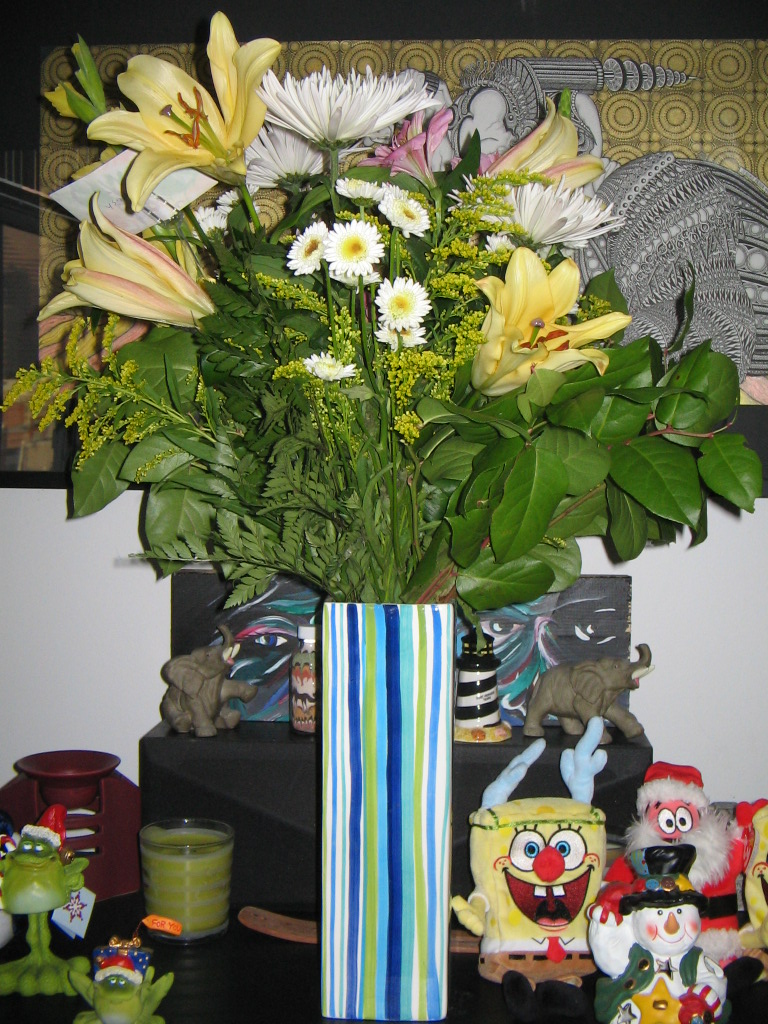 Beautiful arrangement from Sean & Nancy
21 November 2006
Celebration of Brian
There were approximately 100 people at the Pub that night, many stories, memories, laughter and tears were shared.

Here are some group photos Joe got at the event at Ceili's on Monday night. These were taken at the end of the evening, so you could call these people the true survivors of the night. And yes Sean, I didn't forget that I owe you a beer.

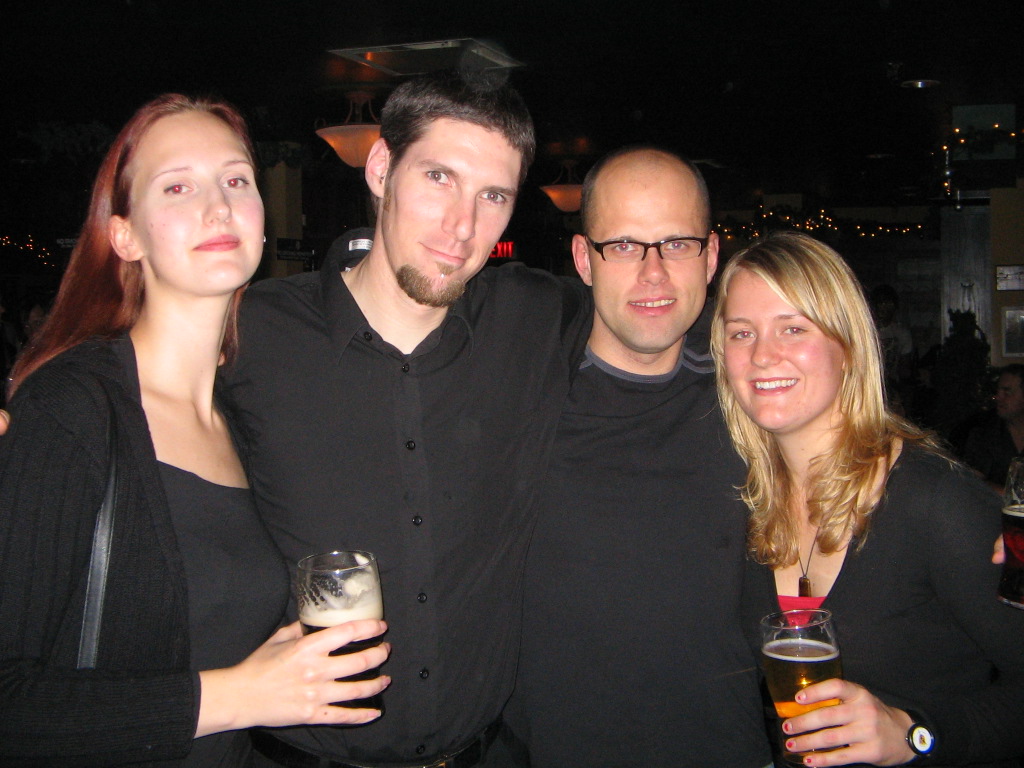
Here are some group photos Joe got at the event at Ceili's on Monday night. These were taken at the end of the evening, so you could call these people the true survivors of the night. And yes Sean, I didn't forget that I owe you a beer.

King of the Mountains

From Jon, here is a picture of the climber's jersey presented to Kevin Kullman last night at the Celebration of Brian at Ceili's.
RIP Buddy
19 November 2006
Cyclists join in tribute ride for enthusiast shot to death


Photographs by : Leah Hennel, Calgary Herald
Sherri Zickefoose, Calgary Herald
Published: Monday, November 20, 2006
With the wind at their backs and a fallen cyclist in their hearts, friends of Brian Kullman pedalled from Bowness to Inglewood on Sunday to honour his memory.
More than 150 friends donned jerseys and Spandex shorts for a memorial ride in tribute to the 39-year-old who was shot to death Nov. 7.
Members of Kullman's beloved Synergy Racing Cycle Club were out in full force at 12:30 p.m. to guide the riders, cycling along one of Kullman's favourite routes. They started from Cadence Cafe on Bowness Road, rode along Memorial Drive and continued on to his Inglewood townhouse.
"I'm completely floored by how many people turned up today," said friend Reid Dalgleish, one of the ride organizers.
Riders lined up first to sign a cycling jersey, which will be presented to Kullman's parents during another gathering tonight at Ceili's Irish Pub.
When the riders reached Kullman's townhouse in Inglewood Grove for a short remembrance ceremony, they were greeted by their friend's black helmet and a memorial poster hanging from the garage door.
Cyclists bowed their heads for a moment of silence before sharing memories of the dedicated cyclist known for his enthusiasm and support of fellow bike riders.
Friend Graeme Thomson urged people to remember Kullman's affectionate nature.
"BK loved to hug people randomly, so before you leave, hug someone next to you," Thomson said, sparking the crowd to open their arms to each other.
Family members were awed by the turnout.
"I'm absolutely moved, as are all of us," said Kullman's uncle, Don Cross, who addressed the crowd as the family spokesman.
"We're all totally blown away and grateful for everything you've done. It makes my heart pound that he has this many friends," Cross said.
"I think we all hope we're loved by people around us. What greater way to show that than this. That says a lot."
Kullman's large circle of friends say they're stunned that a largely unknown business acquaintance who knew Kullman for seven years has been charged in his death.
Bill James Pappas, 35, was arrested last Wednesday at the Calgary International Airport with a one-way ticket to Italy.
He is charged with second-degree murder, arson and fraud.
Suspicious banking activity involving Kullman's account helped lead detectives to the suspect.
Pappas and Kullman, 39, had known each other for seven years, police said. Kullman, a well services programmer, had financial dealings with him in the past.
Police recovered a gun, which is thought to be the murder weapon. They have sent it to the crime lab.
Pappas was a suspect early on, police said. Some of Kullman's friends mentioned the suspect by name in their online blogs, with a plea to contact police with information about him. It's alleged the suspect visited the home as others were leaving the night Kullman was last seen.
A fire was deliberately set in Kullman's Inglewood home Nov. 8 to destroy evidence, police said.
His silver Mercedes-Benz station wagon is believed to have been used by the suspect for days before it was recovered at a southeast parking lot.
Kullman's body was found by hikers Nov. 10 near the side of Highway 66 in Kananaskis Country, near Elbow Falls.
szickefoose@theherald.canwest.com
BK Memorial Ride Highlights
The ride in Brian's honor took place on Sunday, November 19th, starting at Cadence Coffee in Bowness and moving through the city to Brian's house in Inglewood. Approximately 120 riders showed up to pay their respects to the man who had such a positive effect on all of our lives.
Here is a video of the procession going down Memorial Drive.
The Synergy Racing Cycle Club team, past and present, were able to find some comfort in the support of all of our friends in the Alberta cycling community and with each other.
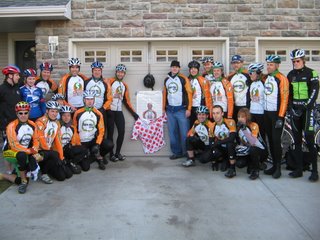
I was also very happy that Brian's family could be present to see what a profound effect Brian had on all of us.
A special thank you should go out to Graeme and Jon, who organized the ride and the ceremonies.

Here is a video of the procession going down Memorial Drive.
The Synergy Racing Cycle Club team, past and present, were able to find some comfort in the support of all of our friends in the Alberta cycling community and with each other.

I was also very happy that Brian's family could be present to see what a profound effect Brian had on all of us.
A special thank you should go out to Graeme and Jon, who organized the ride and the ceremonies.
17 November 2006
The King of the Mountains
My first memory of BK dates back to the Pigeon Lake road race in 2003. It was a cold and rainy day that didn’t exactly have me jumping for joy. I had warmed up with some other Synergists by doing laps up and down the highway but this didn’t prove to be enough as the race started fast and I got dropped on the first hill. I rode on alone for awhile before BK caught up to me. He slowed down and picked me up and we rode the rest of the race together. He could have easily dropped me and ridden on with faster groups that caught up to us but he didn’t. No matter how I was riding, he stayed with me until the end of the race.
This selfless nature has continued over the years as BK and I became better friends and trained and rode together more frequently. Whether we were going for a training ride, cross-country skiing or even racing, BK was always there to make sure his friends and team mates were taken care of. If you needed anything, he would do his best to help you out. Got a flat tire right before a race? No problem, here’s my bike. Hands cold on a winter ride? No problem, here are my gloves. Cracking after a long ride? No problem, here is my energy bar. BK never let you suffer if he could help you out.
BK was one of those weird guys (weird to a heavy track guy like me) who loved to climb. At training camp in Tucson, Brian was always happiest on days when there would be a few hours of climbing to be had. I’m pretty sure that if he lived in Tucson, he’d climb Mt. Lemmon on a weekly basis. His favourite race has always been the Mount Norquay Hill Climb and this year he put in a great time and claimed second place. I think that some of the credit for that can go to Brian’s rigorous training regime that included numerous rides in his Birkenstock sandals. Nothing toughens you up quite like a long, hard ride while wearing sandals, with black socks of course, atop your clipless pedals.
Brian’s passion for climbing was fuelled by his undying love of all things bike tech. If there was something new or cool to be seen or had, I could count on him to know all about it and likely have it on his bike already. Saves you 5g? I’ll take it! Won’t be available in North American until next year? I’ll take it! Looks so cool? I’ll take it. As a fellow bike geek trapped in the cold of Calgary, news of cool new gear always cheered me up.
Brian took this same all in approach to everything he did. If there was an inside scoop or trick to it, he would figure it out. What was really great about him is that he would then share this information with you. As a result of all this, Brian pulled the second best espresso shot in town, not bad for a guy does it for a hobby. I was fortunate enough to enjoy plenty of fine espressos in BK’s kitchen over the years and always looked forward to them.
Brian was a great man, loving friend and avid cyclist. He will be missed by all who were fortunate enough to know him. Brian always had a great big smile on his face and did his best to make sure you left with one too, even if that took chasing you down and hugging you. He offered never ending support and encouragement to everyone in the cycling scene and helped me out on many occasions. I will miss our weekly roller training sessions, espresso shots, and bike geekery but most of all I will miss one of my closest and best friends. I hope that wherever Brian is, he is enjoying long climbs over perfect roads with a never ending tail wind. We’ll miss you Brian.
Jon Keech
Synergy Racing Cycle Club
This selfless nature has continued over the years as BK and I became better friends and trained and rode together more frequently. Whether we were going for a training ride, cross-country skiing or even racing, BK was always there to make sure his friends and team mates were taken care of. If you needed anything, he would do his best to help you out. Got a flat tire right before a race? No problem, here’s my bike. Hands cold on a winter ride? No problem, here are my gloves. Cracking after a long ride? No problem, here is my energy bar. BK never let you suffer if he could help you out.
BK was one of those weird guys (weird to a heavy track guy like me) who loved to climb. At training camp in Tucson, Brian was always happiest on days when there would be a few hours of climbing to be had. I’m pretty sure that if he lived in Tucson, he’d climb Mt. Lemmon on a weekly basis. His favourite race has always been the Mount Norquay Hill Climb and this year he put in a great time and claimed second place. I think that some of the credit for that can go to Brian’s rigorous training regime that included numerous rides in his Birkenstock sandals. Nothing toughens you up quite like a long, hard ride while wearing sandals, with black socks of course, atop your clipless pedals.
Brian’s passion for climbing was fuelled by his undying love of all things bike tech. If there was something new or cool to be seen or had, I could count on him to know all about it and likely have it on his bike already. Saves you 5g? I’ll take it! Won’t be available in North American until next year? I’ll take it! Looks so cool? I’ll take it. As a fellow bike geek trapped in the cold of Calgary, news of cool new gear always cheered me up.
Brian took this same all in approach to everything he did. If there was an inside scoop or trick to it, he would figure it out. What was really great about him is that he would then share this information with you. As a result of all this, Brian pulled the second best espresso shot in town, not bad for a guy does it for a hobby. I was fortunate enough to enjoy plenty of fine espressos in BK’s kitchen over the years and always looked forward to them.
Brian was a great man, loving friend and avid cyclist. He will be missed by all who were fortunate enough to know him. Brian always had a great big smile on his face and did his best to make sure you left with one too, even if that took chasing you down and hugging you. He offered never ending support and encouragement to everyone in the cycling scene and helped me out on many occasions. I will miss our weekly roller training sessions, espresso shots, and bike geekery but most of all I will miss one of my closest and best friends. I hope that wherever Brian is, he is enjoying long climbs over perfect roads with a never ending tail wind. We’ll miss you Brian.
Jon Keech
Synergy Racing Cycle Club
15 November 2006
Media Response
To: Sarah Kennedy
Subject: Re: For the Record
Thank you for the response, Sarah. I appreciate that you took the time to explain your perspective on things.
Admittedly, I have probably unfairly lashed out at the media (and unfairly demonized all of you collectively), but having certain media groups plunder our 'private' public world in the blogosphere for leads and content without permission only added to the shock and anger Brian's group of friends have been going through. If someone had asked for additional pictures for the media to use, I would have gladly supplied dozens. I have been swamped with phone calls and emails since last Wednesday from friends, family, media and investigators running the gamut from support to outrage to insensitivity and this has taken a great emotional toll on me. In all fairness, lashing out at the media in anger didn't give the media outlets a chance to defend themselves, so I really respect that you took the time to write me back.
In retrospect, if I wanted to keep my blog contacts and personal information isolated from the situation surrounding Brian's death I should have started up a separate blog or website specific to this. However, in my haste to get the information out to as many people as possible (which I understand completely you are trying to do as well), I inadvertently exposed myself and my friends to attention none of us really wanted or expected. I fall under the trap of lashing out under emotional duress as much as anyone in a similar situation.
By biggest fear now is that if speculation into the details of the criminal case continue to grow and/or that the police do not release information in a timely manner, this sense of vulnerability and exasperation will not be helped if certain media outlets become more persistent in gathering more information on the story.
That's why I continue to insist that it should be the police that are regarded as the primary source of accurate information and not people personally associated with the victim. Brian had a very wide range of interests and many disparate groups of friends and each of those groups is going to tell you different things. I can only hope (and assume) that the police are doing the best job trying to fit all the pieces of the puzzle together. There is no doubt the media aid in this process, but alternatively the fact that the police are being careful about what pieces of information they release leads me to believe that they are trying to amass evidence and a clear picture in order to present an air-tight criminal case and public presentation.
I've been speculating a thousand different scenarios for a week now as to what happened and it has only led to additional emotional burden. I'd much rather resolve to waiting for the facts to determine some direction to focus my efforts towards once things become more clear and evident. If I can be of any help with information at that point, I definitely will get involved. Right now there's simply no focus as to what information is required from Brian's friends, if any. As far as I know, all of the relationships Brian had that might be related to the case have already been investigated by police.
I know full well that every industry has its individuals and groups with integrity as well as those without, and again I apologize for putting you all together in the same basket.
Regards,
Reid Dalgleish
Date: 15 Nov 2006 10:19:33 -0700
From: "Sarah Kennedy"
Subject: Just for the record
To: reiddalgleish@yahoo.ca
--- Sarah Kennedy wrote:
> Reid, I wanted to make it very clear that the
> Calgary Sun has not lifted so much as ONE picture
> off any of your sites nor have we quoted anything
> printed on any of the blogs and sites.
> There are two newspapers in this city - ours and the
> Herald so if those sort of things are happening,
> it's not because of our paper. And I don't want to
> be associated with that.
> I am extremely extremely sorry for your loss. These
> last few days have been hell for you and I know when
> you're involved in these situations the media can
> come across as being totally cruel and insensitive.
> I think sometimes though, what we do is not entirely
> understood. Although some friends have refused to
> comment on the situation - others have come forward
> and there are also many investigators (some not as
> close to the case as others) who come to us and give
> information both on and off the record. What results
> is a mass of information and rumours - some founded
> and some not - to go towards explaining a) who Brian
> was and b) what could have happened to him. Most
> media in the city (not all) care about being honest
> and accurate which is why we call close friends and
> family - they are usually the only ones who can
> separate the truth from the bullshit.
> Also in our defence, when this story first broke and
> the police had a VERY good idea that Brian had been
> murdered or met with foul play they withheld that
> from us and told us he was just missing and it may
> have been the result of domestic- related fight. As
> the media - we can do a lot of good in helping to
> locate missing people. We do it all the time. We
> print pictures, information and phone numbers people
> can call if they've seen that person. I'd say about
> 80 per cent of the time what we print and broadcast
> was responsible for the safe return of that person
> because of tips generated. That's why initially we
> always call the family. Only they can provide us
> with the details we need about that person. Is this
> out of character for them? Have they have taken off
> before? Were they in any kind of trouble etc...? I
> understand that the calls continued after that point
> and I can only speak for myself in saying that after
> we were told no initially - I have not made any
> calls back to the family.
> I am writing you this to help you understand the way
> the media works. I hate people assuming we are all
> parasites. We do a good public service. If Brian was
> still just missing and you were desperate for any
> details surrounding his whereabouts - I'm sure you
> and your friends would appreciate the media's
> ongoing assistance. It has brought a lot of people
> comfort in times when they feel desperate and don't
> know where else to go for help.
> Once again, I'm so sorry for your loss.
> Brian sounded like a great guy and it's obvious he
> was well loved.
> Take care
> Sarah
Subject: Re: For the Record
Thank you for the response, Sarah. I appreciate that you took the time to explain your perspective on things.
Admittedly, I have probably unfairly lashed out at the media (and unfairly demonized all of you collectively), but having certain media groups plunder our 'private' public world in the blogosphere for leads and content without permission only added to the shock and anger Brian's group of friends have been going through. If someone had asked for additional pictures for the media to use, I would have gladly supplied dozens. I have been swamped with phone calls and emails since last Wednesday from friends, family, media and investigators running the gamut from support to outrage to insensitivity and this has taken a great emotional toll on me. In all fairness, lashing out at the media in anger didn't give the media outlets a chance to defend themselves, so I really respect that you took the time to write me back.
In retrospect, if I wanted to keep my blog contacts and personal information isolated from the situation surrounding Brian's death I should have started up a separate blog or website specific to this. However, in my haste to get the information out to as many people as possible (which I understand completely you are trying to do as well), I inadvertently exposed myself and my friends to attention none of us really wanted or expected. I fall under the trap of lashing out under emotional duress as much as anyone in a similar situation.
By biggest fear now is that if speculation into the details of the criminal case continue to grow and/or that the police do not release information in a timely manner, this sense of vulnerability and exasperation will not be helped if certain media outlets become more persistent in gathering more information on the story.
That's why I continue to insist that it should be the police that are regarded as the primary source of accurate information and not people personally associated with the victim. Brian had a very wide range of interests and many disparate groups of friends and each of those groups is going to tell you different things. I can only hope (and assume) that the police are doing the best job trying to fit all the pieces of the puzzle together. There is no doubt the media aid in this process, but alternatively the fact that the police are being careful about what pieces of information they release leads me to believe that they are trying to amass evidence and a clear picture in order to present an air-tight criminal case and public presentation.
I've been speculating a thousand different scenarios for a week now as to what happened and it has only led to additional emotional burden. I'd much rather resolve to waiting for the facts to determine some direction to focus my efforts towards once things become more clear and evident. If I can be of any help with information at that point, I definitely will get involved. Right now there's simply no focus as to what information is required from Brian's friends, if any. As far as I know, all of the relationships Brian had that might be related to the case have already been investigated by police.
I know full well that every industry has its individuals and groups with integrity as well as those without, and again I apologize for putting you all together in the same basket.
Regards,
Reid Dalgleish
Date: 15 Nov 2006 10:19:33 -0700
From: "Sarah Kennedy"
Subject: Just for the record
To: reiddalgleish@yahoo.ca
--- Sarah Kennedy
> Reid, I wanted to make it very clear that the
> Calgary Sun has not lifted so much as ONE picture
> off any of your sites nor have we quoted anything
> printed on any of the blogs and sites.
> There are two newspapers in this city - ours and the
> Herald so if those sort of things are happening,
> it's not because of our paper. And I don't want to
> be associated with that.
> I am extremely extremely sorry for your loss. These
> last few days have been hell for you and I know when
> you're involved in these situations the media can
> come across as being totally cruel and insensitive.
> I think sometimes though, what we do is not entirely
> understood. Although some friends have refused to
> comment on the situation - others have come forward
> and there are also many investigators (some not as
> close to the case as others) who come to us and give
> information both on and off the record. What results
> is a mass of information and rumours - some founded
> and some not - to go towards explaining a) who Brian
> was and b) what could have happened to him. Most
> media in the city (not all) care about being honest
> and accurate which is why we call close friends and
> family - they are usually the only ones who can
> separate the truth from the bullshit.
> Also in our defence, when this story first broke and
> the police had a VERY good idea that Brian had been
> murdered or met with foul play they withheld that
> from us and told us he was just missing and it may
> have been the result of domestic- related fight. As
> the media - we can do a lot of good in helping to
> locate missing people. We do it all the time. We
> print pictures, information and phone numbers people
> can call if they've seen that person. I'd say about
> 80 per cent of the time what we print and broadcast
> was responsible for the safe return of that person
> because of tips generated. That's why initially we
> always call the family. Only they can provide us
> with the details we need about that person. Is this
> out of character for them? Have they have taken off
> before? Were they in any kind of trouble etc...? I
> understand that the calls continued after that point
> and I can only speak for myself in saying that after
> we were told no initially - I have not made any
> calls back to the family.
> I am writing you this to help you understand the way
> the media works. I hate people assuming we are all
> parasites. We do a good public service. If Brian was
> still just missing and you were desperate for any
> details surrounding his whereabouts - I'm sure you
> and your friends would appreciate the media's
> ongoing assistance. It has brought a lot of people
> comfort in times when they feel desperate and don't
> know where else to go for help.
> Once again, I'm so sorry for your loss.
> Brian sounded like a great guy and it's obvious he
> was well loved.
> Take care
> Sarah
14 November 2006
Dear media
Our blogs have become the source of information to all of our friends trying to make sense of Brian's disappearance. You have lifted pictures off of my blog and have been displaying them on TV and in the local newspapers. With the digital media, I'm okay without granting permission since it is in the public realm. However, with the printed media, I have a bit of issue with this -- don't you need permission or credits for something in print? The press had been supplied a media package which they should continue to use, seriously. If you wanted to add to your media package I would have really appreciated being asked. I could probably make a big deal about this, but it's definitely not the time and I don't have the energy.
We have all been blogging for our own personal communications and reasons, not to have the media grab contact information for anyone and everyone that has been even remotely referenced or related to Brian on this site. You have overwhelmed everyone looking for information on BK's ordeal because of it and that one little bit of overlooked information that you could use to 'get the scoop' on the story.
We have to wait for information from the police, why can't you do the same damn thing? I am removing all references on this site to protect everyone from further disruption during this difficult time since the media can't seem to differentiate between tactfulness and harassment. I'm sorry everyone, I know it's 'too little, too late' to protect your privacy. Maybe under different circumstances it wouldn't be necessary.
In addition to the incessant emails and calls the media have made to everyone remotely associated to Brian, the Herald media group have contacted the Kullman family four times over the earlier part of the weekend and only backed off once the police threatened them.
While I was visiting with Brian's parents on Sunday, a second call from the Calgary Sun came to the house. Don't you people listen or communicate to your staff or amongst yourselves? Shift changes, indeed! Couldn't you see your lack of 'information passing' as a bit of a weakness in your info-gathering process that could come back to bite you in the ass someday?
Leave the poor family alone, please.
Take this as a lesson to those out there in blog land, if your blog is ever in the media's hands, they will pillage your blog for any shred of news to make a story.
My friend Jeff is closing down "Well this is just it". I will be doing the same for "Everything is Wrong" once the need for a location to information on BK is no longer needed.
Everyone is in shock over the unbelievable train of events over the past week, and the last thing I need is to talk to some hounding media person asking me how I feel. Please respect our privacy and back off.
Regards,
Reid Dalgleish
We have all been blogging for our own personal communications and reasons, not to have the media grab contact information for anyone and everyone that has been even remotely referenced or related to Brian on this site. You have overwhelmed everyone looking for information on BK's ordeal because of it and that one little bit of overlooked information that you could use to 'get the scoop' on the story.
We have to wait for information from the police, why can't you do the same damn thing? I am removing all references on this site to protect everyone from further disruption during this difficult time since the media can't seem to differentiate between tactfulness and harassment. I'm sorry everyone, I know it's 'too little, too late' to protect your privacy. Maybe under different circumstances it wouldn't be necessary.
In addition to the incessant emails and calls the media have made to everyone remotely associated to Brian, the Herald media group have contacted the Kullman family four times over the earlier part of the weekend and only backed off once the police threatened them.
While I was visiting with Brian's parents on Sunday, a second call from the Calgary Sun came to the house. Don't you people listen or communicate to your staff or amongst yourselves? Shift changes, indeed! Couldn't you see your lack of 'information passing' as a bit of a weakness in your info-gathering process that could come back to bite you in the ass someday?
Leave the poor family alone, please.
Take this as a lesson to those out there in blog land, if your blog is ever in the media's hands, they will pillage your blog for any shred of news to make a story.
My friend Jeff is closing down "Well this is just it". I will be doing the same for "Everything is Wrong" once the need for a location to information on BK is no longer needed.
Everyone is in shock over the unbelievable train of events over the past week, and the last thing I need is to talk to some hounding media person asking me how I feel. Please respect our privacy and back off.
Regards,
Reid Dalgleish
10 November 2006
Brian Kullman - Missing Person Report

-----------------------------------------------------------------
CITYBEAT - CITY OF CALGARY PRESS RELEASE
-----------------------------------------------------------------
The Calgary Police Service is seeking public assistance in
locating a missing Calgary man.
Brian Wayne KULLMAN, 39, of Calgary went missing from his
southeast Calgary residence at approximately 10 p.m.,
Tuesday, November 7, 2006. Mr. KULLMAN's car is also missing.
KULLMAN is described as a Caucasian male, 6'2", 154 lbs. with
brown eyes, brown hair and a medium build.
Mr. KULLMAN's car is a silver, 2003 Mercedes Benz C240
station wagon.
Anyone with information on the whereabouts of Mr. KULLMAN is
asked to contact police immediately at 540-2858 or 266-1234,
or Crime Stoppers at 1-800-222-TIPS (8477).
BK has been missing for almost three days now. There have been quite a few deadend leads and strange coincidences already affecting the police investigation of the case. As the hours go by, the frustration and stress of not knowing what has happened to Brian is increasing. If ANYONE has any information about BK, a financial investment acquaintance of BK's named Bill, or has had contact with him in the past 60 hours, please contact the police.

06 November 2006
What's with the gay TV doctors? First TR, now Doogie!
'Doogie Howser' star comes out -- with pride
POSTED: 8:58 a.m. EST, November 4, 2006
LOS ANGELES, California (AP) -- Neil Patrick Harris is gay and wants to quell any rumors to the contrary.
"(I) am quite proud to say that I am a very content gay man living my life to the fullest," Harris tells People magazine's Web site.
The 33-year-old actor said he was motivated to disclose his sexuality because of recent "speculation and interest in my private life and relationships."
Harris stars on the CBS comedy "How I Met Your Mother." He started on TV as a teen, playing the namesake doctor on the series "Doogie Howser, M.D."
When I read this, all I could think of was Neil's cameo in "Harold & Kumar Go to White Castle", where he hilariously steals their car on a one-man hunt to find coke and hookers. What a convincing straight-playing man he is! LOL. Way to go Neil. Way to go T.R. Knight. Eventually it won't be considered a career obstacle to come out in Hollywood anymore...especially if you play a doctor!
POSTED: 8:58 a.m. EST, November 4, 2006
LOS ANGELES, California (AP) -- Neil Patrick Harris is gay and wants to quell any rumors to the contrary.
"(I) am quite proud to say that I am a very content gay man living my life to the fullest," Harris tells People magazine's Web site.
The 33-year-old actor said he was motivated to disclose his sexuality because of recent "speculation and interest in my private life and relationships."
Harris stars on the CBS comedy "How I Met Your Mother." He started on TV as a teen, playing the namesake doctor on the series "Doogie Howser, M.D."
When I read this, all I could think of was Neil's cameo in "Harold & Kumar Go to White Castle", where he hilariously steals their car on a one-man hunt to find coke and hookers. What a convincing straight-playing man he is! LOL. Way to go Neil. Way to go T.R. Knight. Eventually it won't be considered a career obstacle to come out in Hollywood anymore...especially if you play a doctor!
Andrew Sullivan thoughts on Ted Haggard
From The Daily Dish:
Quote for the Day
05 Nov 2006 06:13 pm
For those who still - amazingly - believe that being gay is somehow a "choice," consider Haggard. If he could have chosen not to be gay, don't you think he would have? Even though he apparently believes being gay is "repulsive and dark" (while it is, in fact, just another wonderful way to be human), he still cannot prevail against it. It is integral to him. It has been "all of [his] adult life".
One day, he may realize, and I pray he does, that the only dark and repulsive thing is the closet, the betrayal of his wife and children, the destruction of a church, and the demonization of others in the same boat - all as a function of his own inability to face the truth. What is dark and repulsive is dishonesty.
There is no commandment not to be gay. There is a commandment not to bear false witness. Haggard bore false witness - to himself, to his wife, to his traumatized kids, to his fellow gay men and women. repeatedly, pathologically, self-destructively. The right response for Christians is compassion and forgiveness. But also hope: hope that this will help spread the truth about what being gay actually is.
Face it, Ted. Face the truth. It will set you - and so many others - free.
Conservative Degeneracy Watch
05 Nov 2006 07:59 am
A reader writes:
David Frum didn't really argue that a meth-snorting homophobe who for three years cheated on his wife with a male prostitute while at the same time denouncing gay relationships is more moral than an openly gay man, did he? Oh yes he did.
Wha? Hypocrisy as a virtue? Joe. My. God. Read David Frum's blog...if you dare.
Kathryn Lopez didn't really call the piece "excellent," did she? Oh yes she did.
And to think, some people think of the GOP as unhinged or homophobic.
How on earth did anyone get that idea?
He Had Sex
05 Nov 2006 09:37 am
A final confirmation that Haggard was still lying yesterday. But what's interesting to me is that having adulterous gay sex is apparently, in Haggard's mind, a worse sin than buying crystal meth. He copped to the meth before the sex. A reader commented yesterday:
Wrong, it turns out. The drugs-worse-than sex may be a story that works in the mainstream; but among some Christianists, drug abuse is nowhere near as bad as being gay.
Quote for the Day
05 Nov 2006 06:13 pm
"There is part of my life that is so repulsive and dark that I've been warring against it all of my adult life,"- pastor Ted Haggard, referring, I suppose, to his homosexual orientation.
For those who still - amazingly - believe that being gay is somehow a "choice," consider Haggard. If he could have chosen not to be gay, don't you think he would have? Even though he apparently believes being gay is "repulsive and dark" (while it is, in fact, just another wonderful way to be human), he still cannot prevail against it. It is integral to him. It has been "all of [his] adult life".
One day, he may realize, and I pray he does, that the only dark and repulsive thing is the closet, the betrayal of his wife and children, the destruction of a church, and the demonization of others in the same boat - all as a function of his own inability to face the truth. What is dark and repulsive is dishonesty.
There is no commandment not to be gay. There is a commandment not to bear false witness. Haggard bore false witness - to himself, to his wife, to his traumatized kids, to his fellow gay men and women. repeatedly, pathologically, self-destructively. The right response for Christians is compassion and forgiveness. But also hope: hope that this will help spread the truth about what being gay actually is.
Face it, Ted. Face the truth. It will set you - and so many others - free.
Conservative Degeneracy Watch
05 Nov 2006 07:59 am
A reader writes:
David Frum didn't really argue that a meth-snorting homophobe who for three years cheated on his wife with a male prostitute while at the same time denouncing gay relationships is more moral than an openly gay man, did he? Oh yes he did.
Wha? Hypocrisy as a virtue? Joe. My. God. Read David Frum's blog...if you dare.
Kathryn Lopez didn't really call the piece "excellent," did she? Oh yes she did.
And to think, some people think of the GOP as unhinged or homophobic.
How on earth did anyone get that idea?
He Had Sex
05 Nov 2006 09:37 am
A final confirmation that Haggard was still lying yesterday. But what's interesting to me is that having adulterous gay sex is apparently, in Haggard's mind, a worse sin than buying crystal meth. He copped to the meth before the sex. A reader commented yesterday:
It's telling that Rev. Haggard first admission is to purchasing meth. America can tolerate drug stories. We've heard them before. We like them even. The popularity of James Frey's memoir, err, novel, speaks to our affinity for these tales of dissolution and rehabilitation. After all, a user can be redeemed. Not so with a homosexual. What I believe is most horrifying to many Christianists about homosexuality is that it can't be fixed, or worse, that its practitioners do not even desire to be fixed. Gays are sinners who don't want redemption.(emphasis added)
Recall that Rep. Foley used a similar tactic in the unspooling of his confessions. As I remember it, Foley checked into a substance abuse program just days after the allegations of page abuse surfaced. That strategy: turn pedophilia into a story about alcoholism and Foley's own childhood abuse. We don't know how the Haggard story will eventually unfold, but I bet that his handlers will hide the sex behind the smoke of the meth pipe as much as they can.
Wrong, it turns out. The drugs-worse-than sex may be a story that works in the mainstream; but among some Christianists, drug abuse is nowhere near as bad as being gay.
05 November 2006
Good intentions

I had good intentions to work on the template for my blog this weekend as well as finally scratch out a happy post (I know that everyone's waiting anxiously for that one! LOL), but alas I am being completely lazy today. This was a weekend of good intentions, but ended up being more about escape. Doug, Joe and I went to Soda Lounge on Friday night for a DJ set including my friend DJ EZ Quik, and we ended up having a bit too much fun. Saturday morning came way too early. I had to meet Chris and Craig at Peak Power for our baseline measurements and a workout before heading to the ABA AGM in the afternoon. After that I headed home, had a very quick nap and got ready to go out with the gang again. Joe and I headed over to Curtis' place at 9pm and hooked up with Curtis, Doug, Darren, Matt and Jeff. We sat around, had a bunch of laughs and before you knew it, it was 11pm and too late to head to the bar. So what did we do? Go for another run to the liquor store! We stayed at Curtis' place until the wee hours of the morning. I'm so glad I have the group of friends I do - they're really a bunch of great people. I don't know what I'd do without them!
Subscribe to:
Posts (Atom)