Remember these guys?
24 March 2008
Lump in your stocking
Coal crisis hits economies from South Africa to Japan
Long considered an abundant, reliable and relatively cheap source of energy, coal is suddenly in short supply and high demand worldwide. An untimely confluence of bad weather, flawed energy policies, low stockpiles and voracious growth in Asia's appetite has driven international spot prices of coal up by 50% or more in the past five months, surpassing the escalation in oil prices. The signs of a coal crisis have been showing up from mine mouths to factory gates and living rooms: As many as 45 ships were stacked up in Australian ports waiting for coal deliveries slowed by torrential rains. China and Vietnam, which have thrived by sending goods abroad, abruptly banned coal exports, while India's import demands are up. Factory hours have been shortened in parts of China, and blackouts have rippled across South Africa and Indonesia's most populous island, Java. Meanwhile, mining companies are enjoying a windfall. Freight cars in Appalachia are brimming with coal for export, and old coal mines in Japan have been reopened or expanded. European and Japanese coal buyers, worried about future supplies, have begun locking in long-term contracts at high prices, and world steel and concrete prices have risen already, fueling inflation.
Big swings in the prices of coal and other commodities are common. But while the price of coal has slipped slightly in recent weeks, many analysts and companies are wondering whether high prices are here to stay. As increasing numbers of the world's poor join the middle classes, hooking up to electricity grids and buying up more manufactured goods, demand for coal grows. World consumption of coal has grown 30% in the past six years, twice as much as any other energy source. About two-thirds of the fuel supplies electricity plants, and just under a third heads to industrial users, mostly steel and concrete makers. Coal -- a fuel from the era and pages of Charles Dickens -- is almost always dirtier to burn than are other fossil fuels. Although its use accounts for a quarter of world energy consumption, it generates 39% of energy-related carbon dioxide emissions. Climate change concerns could lead to legislation in many countries imposing higher costs on those who burn coal, forcing utilities and factories to become more efficient and curtail its use. Climatologists warn that without technology to capture and store carbon dioxide emissions, burning more coal would be disastrous. Developing countries aren't the only ones using more coal. Throughout the 1980s and 1990s, British coal consumption declined as new sources of oil and natural gas were discovered in the North Sea. However, the trend has reversed and coal consumption has climbed steadily over the past six years, including a 9% jump from 2005 to 2006. Coal has now surpassed gas once again as the leading fuel for electricity plants. However, the British mines that George Orwell described 70 years ago as "like my own mental picture of hell" are much smaller than they once were. Mine production capacity declined during the '80s and '90s "dash for gas." Now Britain imports coal from Russia, Australia, Colombia, South Africa and Indonesia.
(Calgary Herald 080322, Vancouver Sun 080324)
Everything's gone insane. Suddenly, the paradigm shift hits like a ton of coal.
Long considered an abundant, reliable and relatively cheap source of energy, coal is suddenly in short supply and high demand worldwide. An untimely confluence of bad weather, flawed energy policies, low stockpiles and voracious growth in Asia's appetite has driven international spot prices of coal up by 50% or more in the past five months, surpassing the escalation in oil prices. The signs of a coal crisis have been showing up from mine mouths to factory gates and living rooms: As many as 45 ships were stacked up in Australian ports waiting for coal deliveries slowed by torrential rains. China and Vietnam, which have thrived by sending goods abroad, abruptly banned coal exports, while India's import demands are up. Factory hours have been shortened in parts of China, and blackouts have rippled across South Africa and Indonesia's most populous island, Java. Meanwhile, mining companies are enjoying a windfall. Freight cars in Appalachia are brimming with coal for export, and old coal mines in Japan have been reopened or expanded. European and Japanese coal buyers, worried about future supplies, have begun locking in long-term contracts at high prices, and world steel and concrete prices have risen already, fueling inflation.
Big swings in the prices of coal and other commodities are common. But while the price of coal has slipped slightly in recent weeks, many analysts and companies are wondering whether high prices are here to stay. As increasing numbers of the world's poor join the middle classes, hooking up to electricity grids and buying up more manufactured goods, demand for coal grows. World consumption of coal has grown 30% in the past six years, twice as much as any other energy source. About two-thirds of the fuel supplies electricity plants, and just under a third heads to industrial users, mostly steel and concrete makers. Coal -- a fuel from the era and pages of Charles Dickens -- is almost always dirtier to burn than are other fossil fuels. Although its use accounts for a quarter of world energy consumption, it generates 39% of energy-related carbon dioxide emissions. Climate change concerns could lead to legislation in many countries imposing higher costs on those who burn coal, forcing utilities and factories to become more efficient and curtail its use. Climatologists warn that without technology to capture and store carbon dioxide emissions, burning more coal would be disastrous. Developing countries aren't the only ones using more coal. Throughout the 1980s and 1990s, British coal consumption declined as new sources of oil and natural gas were discovered in the North Sea. However, the trend has reversed and coal consumption has climbed steadily over the past six years, including a 9% jump from 2005 to 2006. Coal has now surpassed gas once again as the leading fuel for electricity plants. However, the British mines that George Orwell described 70 years ago as "like my own mental picture of hell" are much smaller than they once were. Mine production capacity declined during the '80s and '90s "dash for gas." Now Britain imports coal from Russia, Australia, Colombia, South Africa and Indonesia.
(Calgary Herald 080322, Vancouver Sun 080324)
Everything's gone insane. Suddenly, the paradigm shift hits like a ton of coal.
Don't be a Dick
Cheney On Two-Thirds Of The American Public Opposing The Iraq War: ‘So?’
This morning, on the fifth anniversary of the Iraq invasion, ABC’s Good Morning America aired an interview with Vice President Cheney on the war. During the segment, Cheney flatly told White House correspondent Martha Raddatz that he doesn’t care about the American public’s views on the war:
CHENEY: On the security front, I think there’s a general consensus that we’ve made major progress, that the surge has worked. That’s been a major success.
RADDATZ: Two-third of Americans say it’s not worth fighting.
CHENEY: So?
RADDATZ So? You don’t care what the American people think?
CHENEY: No. I think you cannot be blown off course by the fluctuations in the public opinion polls.
This opposition to the war is not a “fluctuation” in public opinion. The American public has steadily turned against the war since the 2003 invasion. According to a new CNN poll, just 36 percent of the American public believes that “the situation in Iraq was worth going to war over — down from 68 percent in March 2003, when the war began.”
Even though he doesn’t care what the American public wants, Cheney still thinks he is able — and entitled — to speak for the American public. Last month, Cheney declared, “The American people will not support a policy of retreat.” If Cheney were actually listening to the “American people,” he would know that 61 percent actually supports the redeployment of U.S. troops.
What a fucking tyrant.
This morning, on the fifth anniversary of the Iraq invasion, ABC’s Good Morning America aired an interview with Vice President Cheney on the war. During the segment, Cheney flatly told White House correspondent Martha Raddatz that he doesn’t care about the American public’s views on the war:
CHENEY: On the security front, I think there’s a general consensus that we’ve made major progress, that the surge has worked. That’s been a major success.
RADDATZ: Two-third of Americans say it’s not worth fighting.
CHENEY: So?
RADDATZ So? You don’t care what the American people think?
CHENEY: No. I think you cannot be blown off course by the fluctuations in the public opinion polls.
This opposition to the war is not a “fluctuation” in public opinion. The American public has steadily turned against the war since the 2003 invasion. According to a new CNN poll, just 36 percent of the American public believes that “the situation in Iraq was worth going to war over — down from 68 percent in March 2003, when the war began.”
Even though he doesn’t care what the American public wants, Cheney still thinks he is able — and entitled — to speak for the American public. Last month, Cheney declared, “The American people will not support a policy of retreat.” If Cheney were actually listening to the “American people,” he would know that 61 percent actually supports the redeployment of U.S. troops.
What a fucking tyrant.
23 March 2008
Does this happen anywhere else?
Sun, March 23, 2008
Faces of hate unashamedly spew message
UPDATED: 2008-03-23 04:38:22 MST
Neo-Nazis protected by police during march, in spite of brazen public intimidation tactics
By PABLO FERNANDEZ, CALGARY SUN
Whether we like it or not, the white supremacist movement in the city is growing and scoring points in its quest to spread a message of hate across Calgary.
On Good Friday, during the United Nations' International Day for the Elimination of Racial Discrimination, more than two dozen flag-waving neo-Nazis took over the city's core, publicly and loudly denying the Holocaust, referring to non-whites as an infection and touting the Aryan lineage as the builder of civilizations.
When white supremacists first started congregating publicly in Calgary, it was they who hid their faces behind masks.
But since they started posting pictures of themselves on the Internet with guns and baseball bats -- and after two recent Molotov cocktail attacks in the city were tied to possible white supremacist activity -- it's the counter-protesters who have to hide their faces. One person who knows the danger of standing up against the neo-Nazis is Bonnie Collins.
She, her four children -- aged three to nine -- and her husband, Jason, were all home when their house was fire bombed on Feb. 12.
That moment was painfully relived Friday, when Bonnie -- as part of a counter-demonstration -- confronted the neo-Nazis, who asked her, "How's your house, Bonnie?" while standing behind a cordon of police officers on the front steps of city hall.
"Is it nice and toasty in there? How's Jason and the kids?"
Apart from gaining ground in their intimidation campaign, the neo-Nazis showed they have absolute freedom of movement in Calgary.
They marched, under police escort, from one end of downtown to the other, and although Calgary Police Service members faced the counter-demonstrators the entire time, the white supremacists made it clear to their opponents police were there to protect them, not the neo-Nazis.
In a surreal twist, the Aryan Guard intended to start its march to city hall from Mewata Armoury.
The Department of National Defence installation is home to the King's Own Calgary Regiment and the Calgary Highlanders, two regiments which lost thousands of men fighting the very ideology the neo-Nazis wanted to flaunt at the regiments' front door.
More than 60 years after the fact, many veterans still suffer the memories of the wrath they felt at the receiving end of the Nazi war machine and the sacrifices they had to make to destroy it.
Ironically, it was a group of self-proclaimed anarchists, known as the flag bearers of the counter-culture, who were the most physically active in disrupting the white supremacist rally.
They also paid the highest price, as at least two were detained by cops and many others were forced to give their particulars to police.
"Every time they show up, we have to show up in force," said one of the anarchists.
"But they're growing ... the last time we confronted them, there were only eight of them."
And that's yet another small victory for the Aryan Guard, whose slogans, flags, mocking and hate towards all who are different from them also struck pain in the hearts of many that day.
Two young girls -- one blond, the other Asian -- walked slowly from the street up the steps of city hall to get a closer look at the Aryan rally.
Both pale and leaning on each other, the teens held each other tight as they took hesitant steps.
Another blond girl held tightly onto her boyfriend of Middle East descent as she watched through tears while the neo-Nazis cheered and were escorted by police onto a bus at the end of their rally.
The fact everyone has a right to think, believe and worship as they see fit is what makes Canada the best country in the world -- bar none.
Members of the Aryan Guard also have rights.
But the fact they can intimidate, threaten, recruit and feel comfortable enough to do as they please in full public view is something Calgarians cannot ignore.
What the hell is going on in this crazy world, this fucked-up city? Police escort for Neo-nazis? The city must've had some trouble approving this one, but really. Really? Has Canada become so constitutionally indefensible that we can't even stand up to bullshit like this anymore? This is very troubling and frustrating.
Faces of hate unashamedly spew message
UPDATED: 2008-03-23 04:38:22 MST
Neo-Nazis protected by police during march, in spite of brazen public intimidation tactics
By PABLO FERNANDEZ, CALGARY SUN
Whether we like it or not, the white supremacist movement in the city is growing and scoring points in its quest to spread a message of hate across Calgary.
On Good Friday, during the United Nations' International Day for the Elimination of Racial Discrimination, more than two dozen flag-waving neo-Nazis took over the city's core, publicly and loudly denying the Holocaust, referring to non-whites as an infection and touting the Aryan lineage as the builder of civilizations.
When white supremacists first started congregating publicly in Calgary, it was they who hid their faces behind masks.
But since they started posting pictures of themselves on the Internet with guns and baseball bats -- and after two recent Molotov cocktail attacks in the city were tied to possible white supremacist activity -- it's the counter-protesters who have to hide their faces. One person who knows the danger of standing up against the neo-Nazis is Bonnie Collins.
She, her four children -- aged three to nine -- and her husband, Jason, were all home when their house was fire bombed on Feb. 12.
That moment was painfully relived Friday, when Bonnie -- as part of a counter-demonstration -- confronted the neo-Nazis, who asked her, "How's your house, Bonnie?" while standing behind a cordon of police officers on the front steps of city hall.
"Is it nice and toasty in there? How's Jason and the kids?"
Apart from gaining ground in their intimidation campaign, the neo-Nazis showed they have absolute freedom of movement in Calgary.
They marched, under police escort, from one end of downtown to the other, and although Calgary Police Service members faced the counter-demonstrators the entire time, the white supremacists made it clear to their opponents police were there to protect them, not the neo-Nazis.
In a surreal twist, the Aryan Guard intended to start its march to city hall from Mewata Armoury.
The Department of National Defence installation is home to the King's Own Calgary Regiment and the Calgary Highlanders, two regiments which lost thousands of men fighting the very ideology the neo-Nazis wanted to flaunt at the regiments' front door.
More than 60 years after the fact, many veterans still suffer the memories of the wrath they felt at the receiving end of the Nazi war machine and the sacrifices they had to make to destroy it.
Ironically, it was a group of self-proclaimed anarchists, known as the flag bearers of the counter-culture, who were the most physically active in disrupting the white supremacist rally.
They also paid the highest price, as at least two were detained by cops and many others were forced to give their particulars to police.
"Every time they show up, we have to show up in force," said one of the anarchists.
"But they're growing ... the last time we confronted them, there were only eight of them."
And that's yet another small victory for the Aryan Guard, whose slogans, flags, mocking and hate towards all who are different from them also struck pain in the hearts of many that day.
Two young girls -- one blond, the other Asian -- walked slowly from the street up the steps of city hall to get a closer look at the Aryan rally.
Both pale and leaning on each other, the teens held each other tight as they took hesitant steps.
Another blond girl held tightly onto her boyfriend of Middle East descent as she watched through tears while the neo-Nazis cheered and were escorted by police onto a bus at the end of their rally.
The fact everyone has a right to think, believe and worship as they see fit is what makes Canada the best country in the world -- bar none.
Members of the Aryan Guard also have rights.
But the fact they can intimidate, threaten, recruit and feel comfortable enough to do as they please in full public view is something Calgarians cannot ignore.
What the hell is going on in this crazy world, this fucked-up city? Police escort for Neo-nazis? The city must've had some trouble approving this one, but really. Really? Has Canada become so constitutionally indefensible that we can't even stand up to bullshit like this anymore? This is very troubling and frustrating.
21 March 2008
20/20
I underwent laser eye surgery yesterday to improve my eyesight. It's something that I always contemplate when my vision care plan at work tops up, but this year I had my incentive bonus to bolster the argument to do it when contemplating the cost. Because my astigmatism was so bad, the surgery cost quite a bit more than the average person, however, now that it's done and I'm only fighting a bit of infection in my left eye, I'm amazed and blown away by the improvement. I went in for a follow-up test and I'm seeing 20/20. Incredible. I think I'm only beginning to discover the things that people with good eyesight take for granted. It's the first time in my entire life that I've been able to see without some sort of assistance through glasses or contacts, and if I can see this good today, what's it gonna be like in a month or two when everything's healed? I think this was a great decision. I'm so excited! :-D
17 March 2008
Self-sufficiency
If you don't know how to grow your own food or don't know where to begin, now's as good a time as any to start researching the topic. Start investigating community gardens in your area. The spring is the best time to gain some experience in these areas.
Check out Lawns to Gardens.
Check out Lawns to Gardens.
Monday morning delights
Stocks down, but off lows
NEW YORK (CNNMoney.com) -- Stocks cut losses Monday morning, with the Dow briefly turning higher, as shares of JP Morgan Chase rallied on bets that its bargain basement purchase of Bear Stearns was a good move for the company.
Bond prices surged, lowering corresponding yields, as investors sought the comparative safety of government debt. The dollar plunged to a 12-1/2 year low versus the yen and hit another all-time low versus the euro.
The Dow Jones industrial average (INDU) was down about 0.2% 90 minutes into the session. The broader Standard & Poor's 500 (SPX) index tumbled 0.8%, and the Nasdaq composite (COMP) shed 1.2%.
Stocks tumbled at the open after the sale of Bear Stearns and emergency moves by the Federal Reserve exacerbated fears about the fallout in financial markets.
But the declines were not as aggressive as analysts had been expecting, and select financial shares managed to bounce back as the morning continued.
Bear Stearns. Stocks tumbled Friday on news that Bear Stearns needed emergency funding to avoid a collapse, and fears about the financial sector deepened over the weekend.
On Sunday, JP Morgan Chase agreed to buy Bear for just $2 a share, or $236 million. That's less than 4% of Bear Stearns' value at the close of trading on Thursday. On Friday, Bear shares plunged 47% to close at $30 a share. One year ago, the stock was worth nearly $160. (Full story).
Bear Stearns shares tumbled 84% to less than $5 a share on Monday. But JPMorgan Chase, a Dow component, rallied 10.2%.
Federal regulators accelerated the deal-approval process and the Federal Reserve provided $30 billion in funding, the latest in the central bank's series of drastic steps to protect the financial markets amid the housing and credit crises.
Also on Sunday, the Fed cut the discount rate, a short-term bank lending rate, to 3.25% from 3.5%, as a means of making more cash available to strapped banks. The move occurred just two days ahead of the Fed's regularly scheduled policy meeting.
The central bank could cut the fed funds rate, a consumer lending rate, by as much as a full percentage point at that meeting, traders estimate. The fed funds rate currently stands at 3%.
The Fed also announced Sunday it had created another lending facility that allows big Wall Street firms access to short-term funding.
A variety of financial stocks initially tumbled as investors wondered which company would be next to face a fate similar to that of Bear Stearns, with current speculation turning to Lehman Brothers.
However, by mid-morning, select financials had turned higher, helping the broader market trim losses.
In global trade, Asian markets plunged and European markets fell in afternoon trading.
Other markets. U.S. light crude oil for April delivery fell $3.31 to $106.90 a barrel on the New York Mercantile Exchange after touching an all-time high near $112 in electronic trading.
COMEX gold for April delivery added $13 to $1,012.50 an ounce after hitting an all-time high of $1,017.50 an ounce earlier.
TSX slumps as market gloom deepens
Last Updated: Monday, March 17, 2008 | 12:30 PM ET
CBC News
The Toronto Stock Exchange was deep in negative territory Monday, with jittery investors worried about the depth of the problems in the global financial system.
The S&P/TSX composite index tumbled 300 points to 12,953 at noon ET. That amounted to a slight recovery from its worst level of the morning, when the benchmark index was down was much as 385 points.
Every sector except the gold and health-care group was lower, led by a 2.8 per cent drop in the financials group.
All six of the big banks hit new year-to-date lows. CIBC dropped $2.71 to $57.19; TD fell $1.86 to $59.43; BMO slid $1.10 to $39.07.
Energy stocks fell as oil prices retreated from an overnight record high above $111 US a barrel. Crude futures were trading at $107.15 US, down $3.06 US.
The gold sub-index gained 0.7 per cent. The April gold futures contract was up $17 to $1,016.50 US an ounce, off its overnight high of $1,033.90 US an ounce — a record high.
Bear Stearns collapse spooks markets
On the NYSE, shares of Bear Stearns plunged 85 per cent to $3.81 US as its collapse reached its full magnitude. A week ago, the stock had been trading at $70 US a share.
On Sunday, rival investment bank JP Morgan bought Bear Stearns for $2 US a share in stock after Bear Stearns faced a huge liquidity crisis that required an emergency bailout. Bear Stearns had been a major player in the imploding world of subprime mortgages.
Shares of another investment bank, Lehman Bros., slid 23 per cent as rumours swirled that it might be the next to face a liquidity crisis.
In a statement, Lehman said its cash position was "strong."
The Dow Jones industrial average was down 115 points to 11,836. Shares of JP Morgan — a component of the Dow — jumped nine per cent, helping to keep the Dow from sliding further.
There's widespread speculation the U.S. Federal Reserve will drop its key overnight lending rate by as much as a full percentage point on Tuesday.
U.S. President George W. Bush moved to reassure panicked financial markets Monday.
"We've taken strong, decisive action," Bush said after a White House meeting with U.S. Treasury Secretary Henry Paulson.
In a rare Sunday move, the Fed cut its emergency lending rate to financial institutions by a quarter of a percentage point to 3.25 per cent and expanded the list of financial institutions that can access money at that rate.
"These steps will provide financial institutions with greater assurance of access to funds," Federal Reserve chairman Ben Bernanke told reporters in a conference call late Sunday.
Central banks around the world — including the Bank of Canada — have pledged to inject more than $200 billion US into the global financial system to ease the credit crunch.
While the impact of the credit crunch has been much more muted in Canada, financial stocks in this country have tumbled by 20 to 40 per cent from their highs last year as many banks reported writedowns from credit problems.
It's amazing how the entire financial sector is deluding themselves into believing everything is manageable. Another bailout? Where is all this Fed money coming from? An essential firesale on Bear Stearns? An emergency fed rate change on the weekend? A predicted 100 base-point drop in the lending rate tomorrow?
Sure, there are fundamentals that are still solid, but it looks like the equity markets are going to continue taking one beating after another for some time to come yet. The Fed will keep throwing money at the problems, but this is only temporary and devastating to the American dollar at the same time. I would surmise that at this point, inflation is a minor irritant in the whole scope of things. In fact, if everything priced in USDs gets inflated, it will appear to look like it's worth more on paper...something especially poignant to those home owners in the U.S. who are losing more value on their investments by the day.
"We've taken strong, decisive action."
Yeah, George, the Fed certainly took decisive action. In fact, this is the only action they could take, so no doubt it's decisive. If JP Morgan hadn't scooped up Bear Stearns over the weekend and the assets were going to auction (has JPM shot themselves in the foot with this buy? The only thing making the putrid carcass of Bear Stearns palatable was a $30B flavor package from the Fed), can you imagine what would've unfolded this week? Meltdown, that's what. The Fed's still frantically bucketing water out of the leaky liferaft. Here's hoping it's big enough to stay ahead of the increasing leaks in the walls.
NEW YORK (CNNMoney.com) -- Stocks cut losses Monday morning, with the Dow briefly turning higher, as shares of JP Morgan Chase rallied on bets that its bargain basement purchase of Bear Stearns was a good move for the company.
Bond prices surged, lowering corresponding yields, as investors sought the comparative safety of government debt. The dollar plunged to a 12-1/2 year low versus the yen and hit another all-time low versus the euro.
The Dow Jones industrial average (INDU) was down about 0.2% 90 minutes into the session. The broader Standard & Poor's 500 (SPX) index tumbled 0.8%, and the Nasdaq composite (COMP) shed 1.2%.
Stocks tumbled at the open after the sale of Bear Stearns and emergency moves by the Federal Reserve exacerbated fears about the fallout in financial markets.
But the declines were not as aggressive as analysts had been expecting, and select financial shares managed to bounce back as the morning continued.
Bear Stearns. Stocks tumbled Friday on news that Bear Stearns needed emergency funding to avoid a collapse, and fears about the financial sector deepened over the weekend.
On Sunday, JP Morgan Chase agreed to buy Bear for just $2 a share, or $236 million. That's less than 4% of Bear Stearns' value at the close of trading on Thursday. On Friday, Bear shares plunged 47% to close at $30 a share. One year ago, the stock was worth nearly $160. (Full story).
Bear Stearns shares tumbled 84% to less than $5 a share on Monday. But JPMorgan Chase, a Dow component, rallied 10.2%.
Federal regulators accelerated the deal-approval process and the Federal Reserve provided $30 billion in funding, the latest in the central bank's series of drastic steps to protect the financial markets amid the housing and credit crises.
Also on Sunday, the Fed cut the discount rate, a short-term bank lending rate, to 3.25% from 3.5%, as a means of making more cash available to strapped banks. The move occurred just two days ahead of the Fed's regularly scheduled policy meeting.
The central bank could cut the fed funds rate, a consumer lending rate, by as much as a full percentage point at that meeting, traders estimate. The fed funds rate currently stands at 3%.
The Fed also announced Sunday it had created another lending facility that allows big Wall Street firms access to short-term funding.
A variety of financial stocks initially tumbled as investors wondered which company would be next to face a fate similar to that of Bear Stearns, with current speculation turning to Lehman Brothers.
However, by mid-morning, select financials had turned higher, helping the broader market trim losses.
In global trade, Asian markets plunged and European markets fell in afternoon trading.
Other markets. U.S. light crude oil for April delivery fell $3.31 to $106.90 a barrel on the New York Mercantile Exchange after touching an all-time high near $112 in electronic trading.
COMEX gold for April delivery added $13 to $1,012.50 an ounce after hitting an all-time high of $1,017.50 an ounce earlier.
TSX slumps as market gloom deepens
Last Updated: Monday, March 17, 2008 | 12:30 PM ET
CBC News
The Toronto Stock Exchange was deep in negative territory Monday, with jittery investors worried about the depth of the problems in the global financial system.
The S&P/TSX composite index tumbled 300 points to 12,953 at noon ET. That amounted to a slight recovery from its worst level of the morning, when the benchmark index was down was much as 385 points.
Every sector except the gold and health-care group was lower, led by a 2.8 per cent drop in the financials group.
All six of the big banks hit new year-to-date lows. CIBC dropped $2.71 to $57.19; TD fell $1.86 to $59.43; BMO slid $1.10 to $39.07.
Energy stocks fell as oil prices retreated from an overnight record high above $111 US a barrel. Crude futures were trading at $107.15 US, down $3.06 US.
The gold sub-index gained 0.7 per cent. The April gold futures contract was up $17 to $1,016.50 US an ounce, off its overnight high of $1,033.90 US an ounce — a record high.
Bear Stearns collapse spooks markets
On the NYSE, shares of Bear Stearns plunged 85 per cent to $3.81 US as its collapse reached its full magnitude. A week ago, the stock had been trading at $70 US a share.
On Sunday, rival investment bank JP Morgan bought Bear Stearns for $2 US a share in stock after Bear Stearns faced a huge liquidity crisis that required an emergency bailout. Bear Stearns had been a major player in the imploding world of subprime mortgages.
Shares of another investment bank, Lehman Bros., slid 23 per cent as rumours swirled that it might be the next to face a liquidity crisis.
In a statement, Lehman said its cash position was "strong."
The Dow Jones industrial average was down 115 points to 11,836. Shares of JP Morgan — a component of the Dow — jumped nine per cent, helping to keep the Dow from sliding further.
There's widespread speculation the U.S. Federal Reserve will drop its key overnight lending rate by as much as a full percentage point on Tuesday.
U.S. President George W. Bush moved to reassure panicked financial markets Monday.
"We've taken strong, decisive action," Bush said after a White House meeting with U.S. Treasury Secretary Henry Paulson.
In a rare Sunday move, the Fed cut its emergency lending rate to financial institutions by a quarter of a percentage point to 3.25 per cent and expanded the list of financial institutions that can access money at that rate.
"These steps will provide financial institutions with greater assurance of access to funds," Federal Reserve chairman Ben Bernanke told reporters in a conference call late Sunday.
Central banks around the world — including the Bank of Canada — have pledged to inject more than $200 billion US into the global financial system to ease the credit crunch.
While the impact of the credit crunch has been much more muted in Canada, financial stocks in this country have tumbled by 20 to 40 per cent from their highs last year as many banks reported writedowns from credit problems.
It's amazing how the entire financial sector is deluding themselves into believing everything is manageable. Another bailout? Where is all this Fed money coming from? An essential firesale on Bear Stearns? An emergency fed rate change on the weekend? A predicted 100 base-point drop in the lending rate tomorrow?
Sure, there are fundamentals that are still solid, but it looks like the equity markets are going to continue taking one beating after another for some time to come yet. The Fed will keep throwing money at the problems, but this is only temporary and devastating to the American dollar at the same time. I would surmise that at this point, inflation is a minor irritant in the whole scope of things. In fact, if everything priced in USDs gets inflated, it will appear to look like it's worth more on paper...something especially poignant to those home owners in the U.S. who are losing more value on their investments by the day.
"We've taken strong, decisive action."
Yeah, George, the Fed certainly took decisive action. In fact, this is the only action they could take, so no doubt it's decisive. If JP Morgan hadn't scooped up Bear Stearns over the weekend and the assets were going to auction (has JPM shot themselves in the foot with this buy? The only thing making the putrid carcass of Bear Stearns palatable was a $30B flavor package from the Fed), can you imagine what would've unfolded this week? Meltdown, that's what. The Fed's still frantically bucketing water out of the leaky liferaft. Here's hoping it's big enough to stay ahead of the increasing leaks in the walls.
14 March 2008
It's been a long time...
...since I've posted anything personal. Yeah, I know. Work is madness and frankly, there's enough news out there on a daily basis that I'd need two of me to absorb it all! It's great that I'm sorta kinda protected from all this financial madness that seems to be flying around all over the place. Unfortunately we are all intrinsically connected to this huge belching bloated system that almost seems to be gasping its last few breaths before collapsing into a huge pile of shit.
Frankly, the more abrupt this is, the sooner we can catch a fucking grip as a society and start to retrench back to the things that really matter - optimism, health, family and friends, nature, art. It might be better to get over the hump now before China and India start falling into the same trap. If that happens, we're not just fucked, we're doomed. DOOOOOMMMMMEEEEDDD!
Frankly, the more abrupt this is, the sooner we can catch a fucking grip as a society and start to retrench back to the things that really matter - optimism, health, family and friends, nature, art. It might be better to get over the hump now before China and India start falling into the same trap. If that happens, we're not just fucked, we're doomed. DOOOOOMMMMMEEEEDDD!
11 March 2008
Strike Three?
Markets soar as central banks act on credit crunch
Last Updated: Tuesday, March 11, 2008 | 12:32 PM ET
CBC News
North American stock markets surged Tuesday after the Bank of Canada and other central banks jointly announced they would pump more than $200 billion US into the financial system to ease a global credit squeeze.
The announcement came an hour before markets opened. By 11:45 a.m. ET, the S&P/TSX composite index was up 161 points to 13,166. The Dow Jones industrial average was up 177 points at 11,917. Both had triple-digit declines on Monday. European markets also surged.
The Bank of Canada's share of the liquidity boost is $4 billion, delivered in two installments — half on March 20 and the rest on April 3.
The move follows similar joint action taken last December when global credit markets were tightening.
"Pressures in some of these markets have recently increased again,'' the bank said in a statement on its website. "We all continue to work together and will take appropriate steps to address those liquidity pressures."
The Bank of Canada acted along with the U.S. Federal Reserve, the European Central Bank, the Bank of England, and the Swiss National Bank.
The Fed said it would make up to $200 billion US available to banks in exchange for debt that may be of less-than-stellar quality. The Fed said it would accept non-government mortgage-backed securities as collateral.
Loans would be secured for four weeks rather than the usual overnight time frame.
The lending facility "is intended to promote liquidity in the financing markets for treasury and other collateral and thus to foster the functioning of financial markets more generally," the Fed said.
The global credit squeeze has tightened in the last few weeks, making financial institutions more reluctant to make loans.
Another $200 billion, eh? Should be good to hold this creaking bloated mass together for another few weeks before everything starts to really take on water. The Fed in the U.S. can imagine up as much money as they want, offer negative interest rates, and this pile of festering shit is still going to start collapsing. It's akin to tying a horse onto the back of a 10,000 car freight train moving downhill towards a cliff and expecting it to pull the mass back to safety.
Okay the Fed's a messed-up anomaly in itself, but why are we sitting by and letting the central banks use our money to bail out all these shitty debt instruments? It's ridiculous.
Last Updated: Tuesday, March 11, 2008 | 12:32 PM ET
CBC News
North American stock markets surged Tuesday after the Bank of Canada and other central banks jointly announced they would pump more than $200 billion US into the financial system to ease a global credit squeeze.
The announcement came an hour before markets opened. By 11:45 a.m. ET, the S&P/TSX composite index was up 161 points to 13,166. The Dow Jones industrial average was up 177 points at 11,917. Both had triple-digit declines on Monday. European markets also surged.
The Bank of Canada's share of the liquidity boost is $4 billion, delivered in two installments — half on March 20 and the rest on April 3.
The move follows similar joint action taken last December when global credit markets were tightening.
"Pressures in some of these markets have recently increased again,'' the bank said in a statement on its website. "We all continue to work together and will take appropriate steps to address those liquidity pressures."
The Bank of Canada acted along with the U.S. Federal Reserve, the European Central Bank, the Bank of England, and the Swiss National Bank.
The Fed said it would make up to $200 billion US available to banks in exchange for debt that may be of less-than-stellar quality. The Fed said it would accept non-government mortgage-backed securities as collateral.
Loans would be secured for four weeks rather than the usual overnight time frame.
The lending facility "is intended to promote liquidity in the financing markets for treasury and other collateral and thus to foster the functioning of financial markets more generally," the Fed said.
The global credit squeeze has tightened in the last few weeks, making financial institutions more reluctant to make loans.
Another $200 billion, eh? Should be good to hold this creaking bloated mass together for another few weeks before everything starts to really take on water. The Fed in the U.S. can imagine up as much money as they want, offer negative interest rates, and this pile of festering shit is still going to start collapsing. It's akin to tying a horse onto the back of a 10,000 car freight train moving downhill towards a cliff and expecting it to pull the mass back to safety.
Okay the Fed's a messed-up anomaly in itself, but why are we sitting by and letting the central banks use our money to bail out all these shitty debt instruments? It's ridiculous.
10 March 2008
Blivot
From the Urban Dictionary:
blivot
Twenty pounds of shit in a ten pound bag.
A situation or item that is foolishly perceived to be simple and easily manageable when in fact it is twice as complicated and unmanageable as first foolishly perceived.
Ah, finally a term I can apply to everything happening to us!Politics, the economy, corporations, etc., etc., etc.
blivot
Twenty pounds of shit in a ten pound bag.
A situation or item that is foolishly perceived to be simple and easily manageable when in fact it is twice as complicated and unmanageable as first foolishly perceived.
Ah, finally a term I can apply to everything happening to us!Politics, the economy, corporations, etc., etc., etc.
07 March 2008
Will this one balance out soon?
Crude hits record as US dollar slides
Crude oil rose to a record US$105.97 a barrel in New York on Thursday as the US dollar fell to its lowest level ever against the euro. Energy and metals prices have surged over the past year as the dollar plunged, prompting investors to seek a hedge against inflation. The Organization of Petroleum Exporting Countries refused to increase production targets Wednesday, saying the market has sufficient supply. "As long as the funds and other speculators are seeking returns from commodities that aren't available with bonds, equities or real estate, prices will stay high," said Addison Armstrong, director of market research at Tradition Energy. Crude oil for April delivery rose 95 cents, or 0.9%. Brent crude for April settlement rose 97 cents, or 1%, to $102.61 a barrel, a record close. Futures reached $102.95 a barrel Thursday, a record intraday price. "The oil market has completely left the realm of supply and demand," said Sarah Emerson, managing director of Energy Security Analysis. "Commodities have become just one more asset class for pension funds." The euro rose to a record against the dollar after European Central Bank president Jean-Claude Trichet said there is "strong upward pressure on inflation," signalling he's in no hurry to cut interest rates. The US Federal Reserve has cut the target rate for overnight loans between banks in the US by 2.25 percentage points since September. The ECB's reluctance to follow the Federal Reserve in lowering rates pushed the euro to a record $1.5378 Thursday. "Oil has become a financial vehicle for pension funds to hedge against inflation, terrorist attacks and events in countries like Venezuela and Iran," Emerson said. "OPEC was absolutely right - there's no problem with supply." The 13-nation producer group will hold its next scheduled meeting on Sept. 9.
The flood of speculative investment into oil markets is inflating a price bubble that could pop and send crude prices sharply lower if US petroleum demand continues to slump, analysts warned yesterday. The boom could be setting the stage for its own undoing, many analysts argue, since it is being fuelled by speculators looking to hedge against a declining US dollar and devalued financial assets. Some analysts are forecasting a sharp correction in the price of crude this spring. “It's hard to argue that prices should be higher [now] than they were not too long ago,” said Michael Lynch, president of Strategic Energy and Economic Research, who has forecast that crude markets are set for a massive correction that could eventually bring prices as low as $50 a barrel. “I think this is definitely a bubble because it is financial investors who are putting money into the market, not oil traders.” But others argue that oil prices are heavily influenced by non-market factors, and those factors could extend the crude rally. Unlike other recent bubbles – involving mortgage-backed securities or dot-com stocks, for example – the oil market is often driven by geopolitical concerns, from turmoil in the Middle East to the threat of a war involving Venezuela, by weather-related shocks and by the manipulations of a powerful production cartel that is determined to defend high prices. The stunning price rise has been driven almost exclusively by investors who were bailing out of the dollar and other financial assets and pouring into commodities, Judith Dwarkin, chief economist at Ross Smith Energy Group, said yesterday. “The fundamentals don't support prices at $80, let alone $100,” Dwarkin said. She said global demand growth has slowed in recent years, while spare capacity among members of OPEC has expanded somewhat, even as inventories of gasoline are at robust levels. “The greater prices diverge from what is fundamentally supportable, and the longer they stay at a distance from what is fundamentally supportable, the greater the risk of a correction, and a large one.” She has forecast an average price of $75 a barrel for this year.
(Calgary Herald, Globe and Mail 080307)
This roller coaster ride the oil futures market has been on over the past few months probably won't level out until it is official that the US is in a recession....and of course, the powers that be won't admit that until it is absolutely the last resort. What price oil will level out at is anybody's guess...I just wonder if this $105 bbl price is going to trickle down to consumers across the board, or whether the price will settle somewhere lower before the pressure of this price does have a global impact. I think the US economy is in the toilet already, thus will every other nation's economy be within the next two years.
"Oil has become a financial vehicle for pension funds to hedge against inflation, terrorist attacks and events in countries like Venezuela and Iran."
Why do you think this is, and why is it having such an effect on the price of oil? My take on this is that with Peak oil either having passed or being on the horizon, there's no slack in the system to absorb any sort of unknown, so now that is continuously being factored into the price of ALL commodities, not just oil, because extraction of all other commodities are collectively dependent on, you guessed it, oil. Without gobs and gobs of cheap oil to flood the system, the fundamental economics of everything are being forced to change. We're only seeing the beginning of this trend...
Crude oil rose to a record US$105.97 a barrel in New York on Thursday as the US dollar fell to its lowest level ever against the euro. Energy and metals prices have surged over the past year as the dollar plunged, prompting investors to seek a hedge against inflation. The Organization of Petroleum Exporting Countries refused to increase production targets Wednesday, saying the market has sufficient supply. "As long as the funds and other speculators are seeking returns from commodities that aren't available with bonds, equities or real estate, prices will stay high," said Addison Armstrong, director of market research at Tradition Energy. Crude oil for April delivery rose 95 cents, or 0.9%. Brent crude for April settlement rose 97 cents, or 1%, to $102.61 a barrel, a record close. Futures reached $102.95 a barrel Thursday, a record intraday price. "The oil market has completely left the realm of supply and demand," said Sarah Emerson, managing director of Energy Security Analysis. "Commodities have become just one more asset class for pension funds." The euro rose to a record against the dollar after European Central Bank president Jean-Claude Trichet said there is "strong upward pressure on inflation," signalling he's in no hurry to cut interest rates. The US Federal Reserve has cut the target rate for overnight loans between banks in the US by 2.25 percentage points since September. The ECB's reluctance to follow the Federal Reserve in lowering rates pushed the euro to a record $1.5378 Thursday. "Oil has become a financial vehicle for pension funds to hedge against inflation, terrorist attacks and events in countries like Venezuela and Iran," Emerson said. "OPEC was absolutely right - there's no problem with supply." The 13-nation producer group will hold its next scheduled meeting on Sept. 9.
The flood of speculative investment into oil markets is inflating a price bubble that could pop and send crude prices sharply lower if US petroleum demand continues to slump, analysts warned yesterday. The boom could be setting the stage for its own undoing, many analysts argue, since it is being fuelled by speculators looking to hedge against a declining US dollar and devalued financial assets. Some analysts are forecasting a sharp correction in the price of crude this spring. “It's hard to argue that prices should be higher [now] than they were not too long ago,” said Michael Lynch, president of Strategic Energy and Economic Research, who has forecast that crude markets are set for a massive correction that could eventually bring prices as low as $50 a barrel. “I think this is definitely a bubble because it is financial investors who are putting money into the market, not oil traders.” But others argue that oil prices are heavily influenced by non-market factors, and those factors could extend the crude rally. Unlike other recent bubbles – involving mortgage-backed securities or dot-com stocks, for example – the oil market is often driven by geopolitical concerns, from turmoil in the Middle East to the threat of a war involving Venezuela, by weather-related shocks and by the manipulations of a powerful production cartel that is determined to defend high prices. The stunning price rise has been driven almost exclusively by investors who were bailing out of the dollar and other financial assets and pouring into commodities, Judith Dwarkin, chief economist at Ross Smith Energy Group, said yesterday. “The fundamentals don't support prices at $80, let alone $100,” Dwarkin said. She said global demand growth has slowed in recent years, while spare capacity among members of OPEC has expanded somewhat, even as inventories of gasoline are at robust levels. “The greater prices diverge from what is fundamentally supportable, and the longer they stay at a distance from what is fundamentally supportable, the greater the risk of a correction, and a large one.” She has forecast an average price of $75 a barrel for this year.
(Calgary Herald, Globe and Mail 080307)
This roller coaster ride the oil futures market has been on over the past few months probably won't level out until it is official that the US is in a recession....and of course, the powers that be won't admit that until it is absolutely the last resort. What price oil will level out at is anybody's guess...I just wonder if this $105 bbl price is going to trickle down to consumers across the board, or whether the price will settle somewhere lower before the pressure of this price does have a global impact. I think the US economy is in the toilet already, thus will every other nation's economy be within the next two years.
"Oil has become a financial vehicle for pension funds to hedge against inflation, terrorist attacks and events in countries like Venezuela and Iran."
Why do you think this is, and why is it having such an effect on the price of oil? My take on this is that with Peak oil either having passed or being on the horizon, there's no slack in the system to absorb any sort of unknown, so now that is continuously being factored into the price of ALL commodities, not just oil, because extraction of all other commodities are collectively dependent on, you guessed it, oil. Without gobs and gobs of cheap oil to flood the system, the fundamental economics of everything are being forced to change. We're only seeing the beginning of this trend...
Go Saskabush Go!
$4B project would be biggest in SK history
Reginans got a close-up look at what could be the single biggest capital project in the province's history at an open house at the Hotel Saskatchewan Thursday, "If we go ahead with it, it will be the largest single capital investment in the province to date,” said John Jenkins, commercial manager of the Belle Plaine polygeneration project for TransCanada. The $4-billion project would convert petroleum coke - likely from northern Alberta - into 300 megawatts of electricity, as well as hydrogen, nitrogen, steam and carbon dioxide for industrial use. "It's industrial-chemical facility on top of a power plant,” Jenkins said prior to Thursday evening's open house. "That's really what it is." The polygeneration project would also be the first of its kind in Canada, although the technology of gasification is used in about 140 plants worldwide. What makes this plant different is the use of petroleum coke which will shipped by rail to Belle Plaine from Fort McMurray, AB. Jenkins said TransCanada looked at other potential feedstock, including lignite coal from southern Saskatchewan and petroleum coke from the Consumers' Co-operative Refineries refinery-upgrader complex in Regina. But neither of those could generate the same range of industrial product streams at the same price as petroleum coke from Alberta. Another unique aspect of the Belle Plaine project is its location in the middle of a major industrial complex, consisting of the Saskferco nitrogen fertilizer plant, Mosaic's solution potash mine and the soon-to-be producing Terra Grain Fuels ethanol plant. Jenkins said both Mosaic and Saskferco would be major customers of the plant's outputs, including hydrogen, steam and electricity. Water would be readily available from Buffalo Pound Lake through SaskWater, pending approval from environmental authorities, he said. Jenkins noted Belle Plaine is also "close to the oilpatch,” which would be major customer of the CO2 produced by the polygeneration plant for use in enhanced oil recovery projects. "There's good confidence that there will be a market for the CO2 in the province." But Jenkins said TransCanada would like to see a more defined regulatory regime and carbon market in place before giving the go-ahead for the project. "It's a delicate balance between having the rules and regulations in place versus moving with the expectation that they will be put in place,” he said.
(Regina Leader-Post 080307)
It's great to see that fate might be smiling on Saskatchewan these days after decades of neglect.
Reginans got a close-up look at what could be the single biggest capital project in the province's history at an open house at the Hotel Saskatchewan Thursday, "If we go ahead with it, it will be the largest single capital investment in the province to date,” said John Jenkins, commercial manager of the Belle Plaine polygeneration project for TransCanada. The $4-billion project would convert petroleum coke - likely from northern Alberta - into 300 megawatts of electricity, as well as hydrogen, nitrogen, steam and carbon dioxide for industrial use. "It's industrial-chemical facility on top of a power plant,” Jenkins said prior to Thursday evening's open house. "That's really what it is." The polygeneration project would also be the first of its kind in Canada, although the technology of gasification is used in about 140 plants worldwide. What makes this plant different is the use of petroleum coke which will shipped by rail to Belle Plaine from Fort McMurray, AB. Jenkins said TransCanada looked at other potential feedstock, including lignite coal from southern Saskatchewan and petroleum coke from the Consumers' Co-operative Refineries refinery-upgrader complex in Regina. But neither of those could generate the same range of industrial product streams at the same price as petroleum coke from Alberta. Another unique aspect of the Belle Plaine project is its location in the middle of a major industrial complex, consisting of the Saskferco nitrogen fertilizer plant, Mosaic's solution potash mine and the soon-to-be producing Terra Grain Fuels ethanol plant. Jenkins said both Mosaic and Saskferco would be major customers of the plant's outputs, including hydrogen, steam and electricity. Water would be readily available from Buffalo Pound Lake through SaskWater, pending approval from environmental authorities, he said. Jenkins noted Belle Plaine is also "close to the oilpatch,” which would be major customer of the CO2 produced by the polygeneration plant for use in enhanced oil recovery projects. "There's good confidence that there will be a market for the CO2 in the province." But Jenkins said TransCanada would like to see a more defined regulatory regime and carbon market in place before giving the go-ahead for the project. "It's a delicate balance between having the rules and regulations in place versus moving with the expectation that they will be put in place,” he said.
(Regina Leader-Post 080307)
It's great to see that fate might be smiling on Saskatchewan these days after decades of neglect.
Polluted
The world's dirtiest cities
Tiffany M. Luck Yahoo! News
Unless you're in the oil business, there's little reason to brave the choking pollution of Baku, Azerbaijan. Fetid water, oil ponds and life-threatening levels of air pollution emitted from drilling and shipping land the former Soviet manufacturing center at the bottom of this year's list as the world's dirtiest city.
Baku is bad, but far from alone. For residents of the 25 cities on this year's list, black plumes of smoke, acid rain and free-flowing sewage are part of everyday life. Not as immediately visible: the impact on the population's health and life expectancy.
To see which cities in the world were dirtiest, we turned to Mercer Human Resource Consulting's 2007 Health and Sanitation Rankings. As part of their 2007 Quality of Life Report, they ranked 215 cities worldwide based on levels of air pollution, waste management, water potability, hospital services, medical supplies and the presence of infectious disease.
All cities are positioned against New York, the base city with an index score of 100. For the Health and Sanitation Rankings, the index scores range from the worst on the list--Baku, Azerbaijan, with a score of 27.6--to the best on the list--Calgary, Canada, with a score of 131.7.
Lead-poisoned air lands Dhaka, Bangladesh, the No. 2 spot on the list. Traffic congestion in the capital continues to worsen with vehicles emitting fatal amounts of air pollutants daily, including lead. The World Bank-funded Air Quality Management Project aims to help.
"Addressing air pollution is the easiest way to be able to fix someone's well-being because we're always breathing, and there are all sorts of harmful particulates in the air," says Richard Fuller, founder of the New York-based Blacksmith Institute, a non-profit dedicated to solving the pollution problems of the developing world. "In fact, the biggest pathway for lead poisoning is particulates in the air. So in areas with a lot of air pollution, shutting down the worst forces of these types of pollution really does make a difference."
Nos. 3 and 4 on this year's list are the capital cities of Madagascar and Haiti, respectively. Antananarivo, Madagascar and Port au Prince, Haiti, both face the challenge of a rapidly growing urban population and the ever-growing need for efficient water and waste management.
Mexico City, Mexico, ranks No. 5 on this year's list. Residents can thank industrial and automobile emissions for air quality so bad that city ozone levels fail to meet World Health Organization standards an estimated 300 days of the year. But things could be worse.
"Mexico City has actually seen great improvement recently in terms of air pollution," says Dave Calkins, founder of the Sierra Nevada Air Quality Group and former chief of the Air Planning Branch of the U.S. Environmental Protection Agency in San Francisco. "So much so that the government actually has to campaign to let everyone know that pollution is still a problem."
Economies suffer, too. Health care costs and lost productivity drag on business. Companies also face added costs in the form of remuneration packages when relocating employees and their families to some of these cities, noted Slagin Parakatil, senior researcher at Mercer. Cost-benefit analysis certainly suggests making progress toward cleanup. According to a study done by WaterAid, for every US$1 spent on improved sanitation, the benefit equals US$9 resulting from decreased cost of health care and increased productivity.
"If you do the numbers," says Fuller, "to clean up the worst of it doesn't really cost that much. It's the 90/10 rule. To do 90% of the work only costs 10% of the money. It's the last 10% of the cleanup that costs 90% of the money. For relatively little, we can do an awful lot to save a whole lot of lives."
Calgary #1? Guh? What? The stench of car exhaust permeates this city's air most of the time too. It's only those mighty 24/7 winds that are our saving grace. When the winds aren't blowing, there's that lovely ozone bowl that hangs over the valley much like any other city. If we're the best, I can't even imagine what Baku or Mexico City or Beijing are like. Modern society is fucking nuts. Nothing is more important than quality of life (or maybe that is the modern civilization part of me talking there? Most of our ancestors lived in misery), yet we seem complacent to put that irritating detail to the side for the sake of 'progress' and 'profit'. Seems like a horrible price to pay for greed and affluence far beyond what we need or deserve. Ironically, the pollution we put up with is partly responsible for the affluence we enjoy in Western society. Only that today we've been clever about it as we've offshored it all to the poorer nations in order for us to not have it in our collective consciousness all the time. And we still feel that there's too much pollution.....wow.
Tiffany M. Luck Yahoo! News
Unless you're in the oil business, there's little reason to brave the choking pollution of Baku, Azerbaijan. Fetid water, oil ponds and life-threatening levels of air pollution emitted from drilling and shipping land the former Soviet manufacturing center at the bottom of this year's list as the world's dirtiest city.
Baku is bad, but far from alone. For residents of the 25 cities on this year's list, black plumes of smoke, acid rain and free-flowing sewage are part of everyday life. Not as immediately visible: the impact on the population's health and life expectancy.
To see which cities in the world were dirtiest, we turned to Mercer Human Resource Consulting's 2007 Health and Sanitation Rankings. As part of their 2007 Quality of Life Report, they ranked 215 cities worldwide based on levels of air pollution, waste management, water potability, hospital services, medical supplies and the presence of infectious disease.
All cities are positioned against New York, the base city with an index score of 100. For the Health and Sanitation Rankings, the index scores range from the worst on the list--Baku, Azerbaijan, with a score of 27.6--to the best on the list--Calgary, Canada, with a score of 131.7.
Lead-poisoned air lands Dhaka, Bangladesh, the No. 2 spot on the list. Traffic congestion in the capital continues to worsen with vehicles emitting fatal amounts of air pollutants daily, including lead. The World Bank-funded Air Quality Management Project aims to help.
"Addressing air pollution is the easiest way to be able to fix someone's well-being because we're always breathing, and there are all sorts of harmful particulates in the air," says Richard Fuller, founder of the New York-based Blacksmith Institute, a non-profit dedicated to solving the pollution problems of the developing world. "In fact, the biggest pathway for lead poisoning is particulates in the air. So in areas with a lot of air pollution, shutting down the worst forces of these types of pollution really does make a difference."
Nos. 3 and 4 on this year's list are the capital cities of Madagascar and Haiti, respectively. Antananarivo, Madagascar and Port au Prince, Haiti, both face the challenge of a rapidly growing urban population and the ever-growing need for efficient water and waste management.
Mexico City, Mexico, ranks No. 5 on this year's list. Residents can thank industrial and automobile emissions for air quality so bad that city ozone levels fail to meet World Health Organization standards an estimated 300 days of the year. But things could be worse.
"Mexico City has actually seen great improvement recently in terms of air pollution," says Dave Calkins, founder of the Sierra Nevada Air Quality Group and former chief of the Air Planning Branch of the U.S. Environmental Protection Agency in San Francisco. "So much so that the government actually has to campaign to let everyone know that pollution is still a problem."
Economies suffer, too. Health care costs and lost productivity drag on business. Companies also face added costs in the form of remuneration packages when relocating employees and their families to some of these cities, noted Slagin Parakatil, senior researcher at Mercer. Cost-benefit analysis certainly suggests making progress toward cleanup. According to a study done by WaterAid, for every US$1 spent on improved sanitation, the benefit equals US$9 resulting from decreased cost of health care and increased productivity.
"If you do the numbers," says Fuller, "to clean up the worst of it doesn't really cost that much. It's the 90/10 rule. To do 90% of the work only costs 10% of the money. It's the last 10% of the cleanup that costs 90% of the money. For relatively little, we can do an awful lot to save a whole lot of lives."
Calgary #1? Guh? What? The stench of car exhaust permeates this city's air most of the time too. It's only those mighty 24/7 winds that are our saving grace. When the winds aren't blowing, there's that lovely ozone bowl that hangs over the valley much like any other city. If we're the best, I can't even imagine what Baku or Mexico City or Beijing are like. Modern society is fucking nuts. Nothing is more important than quality of life (or maybe that is the modern civilization part of me talking there? Most of our ancestors lived in misery), yet we seem complacent to put that irritating detail to the side for the sake of 'progress' and 'profit'. Seems like a horrible price to pay for greed and affluence far beyond what we need or deserve. Ironically, the pollution we put up with is partly responsible for the affluence we enjoy in Western society. Only that today we've been clever about it as we've offshored it all to the poorer nations in order for us to not have it in our collective consciousness all the time. And we still feel that there's too much pollution.....wow.
06 March 2008
Billionaire Watch 2008
The world's billionaires
Luisa Kroll, Yahoo! News
The number 13 has long been considered unlucky by superstitious people around the globe. How fitting, then, that Bill Gates' reign as the world's richest person ends after his 13th year at the top.
Despite being worth CA$57.2 billion, CA$1.97 billion more than last year, Gates is now just the world's third-richest person, ceding the top spot ranking to his good friend and partner in philanthropy, Warren Buffett, whose net worth jumped CA$9.86 billion to CA$61.15 billion. (All stock prices and net worth valuations were locked in on Feb. 11.) Ranked No. 2 is Mexican telecom tycoon Carlos Slim Helú, whose fortune has doubled in just two years to CA$59.18 billion.
It is certainly a dawning of a new era. But not just because of Gates' fall. The 22nd annual rankings of the World's Billionaires reflects all sorts of upheavals in the list's makeup. Two years ago, half of the world's 20 richest were from the U.S. Now only four are. India wins bragging rights for having four among the top 10, more than any other country.
For the first time ever, the number of billionaires Forbes could identify crossed into four figures, reaching 1,125. The total net worth of the group is CA$4.36 trillion, up CA$892 billion from last year. Despite the turbulence in the U.S. markets, Americans account for 42% of the world's billionaires and 37%, of the total wealth; those shares are down two and three percentage points, respectively, from last year.
Sixteen years after the collapse of the Soviet Union, Russia, with 87 billionaires, is the new No. 2 country behind the U.S., easily overtaking Germany, with 59 billionaires, which held the honor for six years.
The rankings include 226 newcomers. Seventy-seven of the new faces come from the U.S., half of whom made their fortunes in finance and investments, including John Paulson and Philip Falcone, both of whom became wealthy shorting subprime debt. Another third of the new billionaires comes from Russia (35), China (28) and India (19). Two of the most noteworthy new entrants are South Africa's Patrice Motsepe and Nigeria's Aliko Dangote, the first black Africans to make their debut among the world's richest. Dangote is also the first-ever Nigerian billionaire.
It is also a record-breaking year for young billionaires, with Forbes finding 50 under the age of 40, 25 of whom are new to the list. Sixty-eight percent of these under-age-40 tycoons built their 10-figure fortunes from scratch, including Google co-founders Sergey Brin and Larry Page; former Enron trader John Arnold, who now runs a hedge fund; India's Sameer Gehlaut, who started online brokerage Indiabulls; and, last but not least, Facebook founder Mark Zuckerberg, who at age 23 might just be the youngest self-made billionaire in history.
Zuckerberg is probably destined to be the most talked about newcomer of the year because of his age and ingenious social-networking site, but there are fascinating entrepreneurs of all ages climbing into the ranks. Some of the more notable ones include China's Gao Dekang, who is one of the world's biggest makers of down jackets and vests; Portugal's Americo Amorim, who turned his grandfather's small cork operation into the world's largest; and Brazil's Eike Batista, who built and lost a gold mining fortune, before hitting it big in iron ore. He is now the world's richest mining billionaire.
With all the rosy news of the past year and the overall gains, it is easy to lose sight of the volatility that has been wreaking havoc on these fortunes on a daily basis for months. For instance, Hong Kong's richest person, Li Ka-shing, lost CA$5.45 billion of his net worth, all tied to publicly held stocks, in the 37 days between Jan. 4 and Feb. 11.
Meanwhile, mainland China's richest person, 26-year-old Yang Huiyan, fell from CA$17.15 billion in September to CA$7.33 billion in the rankings. Google co-founder Sergey Brin's fortune touched CA$25.27 billion in the past year but is now down to CA$18.53 billion. Others were hit much harder, falling off the list entirely, including Lehman Brothers chief Richard Fuld and Bear Stearns ex-chief James Cayne (he was sacked), both victims of the world's credit crunch, and Pulte Homes' William Pulte, whose stock collapsed along with the housing market.
What will happen in the next 12 months as we continue our wealth watching? There will likely be some big losers, some big winners and a lot of ups and downs in between. The only certainty is change itself.
The only certainty is that a handful of people will always control a majority of the world's wealth and power while a huge majority (like, 99.9% of humanity) will only be ekeing out enough of a living just to keep food on the table. What a weird world we live in...
Luisa Kroll, Yahoo! News
The number 13 has long been considered unlucky by superstitious people around the globe. How fitting, then, that Bill Gates' reign as the world's richest person ends after his 13th year at the top.
Despite being worth CA$57.2 billion, CA$1.97 billion more than last year, Gates is now just the world's third-richest person, ceding the top spot ranking to his good friend and partner in philanthropy, Warren Buffett, whose net worth jumped CA$9.86 billion to CA$61.15 billion. (All stock prices and net worth valuations were locked in on Feb. 11.) Ranked No. 2 is Mexican telecom tycoon Carlos Slim Helú, whose fortune has doubled in just two years to CA$59.18 billion.
It is certainly a dawning of a new era. But not just because of Gates' fall. The 22nd annual rankings of the World's Billionaires reflects all sorts of upheavals in the list's makeup. Two years ago, half of the world's 20 richest were from the U.S. Now only four are. India wins bragging rights for having four among the top 10, more than any other country.
For the first time ever, the number of billionaires Forbes could identify crossed into four figures, reaching 1,125. The total net worth of the group is CA$4.36 trillion, up CA$892 billion from last year. Despite the turbulence in the U.S. markets, Americans account for 42% of the world's billionaires and 37%, of the total wealth; those shares are down two and three percentage points, respectively, from last year.
Sixteen years after the collapse of the Soviet Union, Russia, with 87 billionaires, is the new No. 2 country behind the U.S., easily overtaking Germany, with 59 billionaires, which held the honor for six years.
The rankings include 226 newcomers. Seventy-seven of the new faces come from the U.S., half of whom made their fortunes in finance and investments, including John Paulson and Philip Falcone, both of whom became wealthy shorting subprime debt. Another third of the new billionaires comes from Russia (35), China (28) and India (19). Two of the most noteworthy new entrants are South Africa's Patrice Motsepe and Nigeria's Aliko Dangote, the first black Africans to make their debut among the world's richest. Dangote is also the first-ever Nigerian billionaire.
It is also a record-breaking year for young billionaires, with Forbes finding 50 under the age of 40, 25 of whom are new to the list. Sixty-eight percent of these under-age-40 tycoons built their 10-figure fortunes from scratch, including Google co-founders Sergey Brin and Larry Page; former Enron trader John Arnold, who now runs a hedge fund; India's Sameer Gehlaut, who started online brokerage Indiabulls; and, last but not least, Facebook founder Mark Zuckerberg, who at age 23 might just be the youngest self-made billionaire in history.
Zuckerberg is probably destined to be the most talked about newcomer of the year because of his age and ingenious social-networking site, but there are fascinating entrepreneurs of all ages climbing into the ranks. Some of the more notable ones include China's Gao Dekang, who is one of the world's biggest makers of down jackets and vests; Portugal's Americo Amorim, who turned his grandfather's small cork operation into the world's largest; and Brazil's Eike Batista, who built and lost a gold mining fortune, before hitting it big in iron ore. He is now the world's richest mining billionaire.
With all the rosy news of the past year and the overall gains, it is easy to lose sight of the volatility that has been wreaking havoc on these fortunes on a daily basis for months. For instance, Hong Kong's richest person, Li Ka-shing, lost CA$5.45 billion of his net worth, all tied to publicly held stocks, in the 37 days between Jan. 4 and Feb. 11.
Meanwhile, mainland China's richest person, 26-year-old Yang Huiyan, fell from CA$17.15 billion in September to CA$7.33 billion in the rankings. Google co-founder Sergey Brin's fortune touched CA$25.27 billion in the past year but is now down to CA$18.53 billion. Others were hit much harder, falling off the list entirely, including Lehman Brothers chief Richard Fuld and Bear Stearns ex-chief James Cayne (he was sacked), both victims of the world's credit crunch, and Pulte Homes' William Pulte, whose stock collapsed along with the housing market.
What will happen in the next 12 months as we continue our wealth watching? There will likely be some big losers, some big winners and a lot of ups and downs in between. The only certainty is change itself.
The only certainty is that a handful of people will always control a majority of the world's wealth and power while a huge majority (like, 99.9% of humanity) will only be ekeing out enough of a living just to keep food on the table. What a weird world we live in...
05 March 2008
There is more of a connection than I thought...
Moses was high on drugs: Israeli researcher
Tue Mar 4, 7:03 AM
JERUSALEM (AFP) - High on Mount Sinai, Moses was on psychedelic drugs when he heard God deliver the Ten Commandments, an Israeli researcher claimed in a study published this week.
Such mind-altering substances formed an integral part of the religious rites of Israelites in biblical times, Benny Shanon, a professor of cognitive psychology at the Hebrew University of Jerusalem wrote in the Time and Mind journal of philosophy.
"As far Moses on Mount Sinai is concerned, it was either a supernatural cosmic event, which I don't believe, or a legend, which I don't believe either, or finally, and this is very probable, an event that joined Moses and the people of Israel under the effect of narcotics," Shanon told Israeli public radio on Tuesday.
Moses was probably also on drugs when he saw the "burning bush," suggested Shanon, who said he himself has dabbled with such substances.
"The Bible says people see sounds, and that is a clasic phenomenon," he said citing the example of religious ceremonies in the Amazon in which drugs are used that induce people to "see music."
He mentioned his own experience when he used ayahuasca, a powerful psychotropic plant, during a religious ceremony in Brazil's Amazon forest in 1991. "I experienced visions that had spiritual-religious connotations," Shanon said.
He said the psychedelic effects of ayahuasca were comparable to those produced by concoctions based on bark of the acacia tree, that is frequently mentioned in the Bible.
Isn't it fascinating that an entire religion could be fundamentally driven by the relationship between psychotic drugs and 'divine intervention' -- talking trees, animals, seeing sounds, hearing colors....it actually makes a lot more sense that this is what actually happened than some of the strict interpretations that go on to defend and uphold the tenets of the major religions.

The three best things in the world...Joe, Juicy Fruit weed, and the Jesus Action Figure with REAL GLIDING ACTION! PRAISE THE LORD! HALLELUJAH!
Tue Mar 4, 7:03 AM
JERUSALEM (AFP) - High on Mount Sinai, Moses was on psychedelic drugs when he heard God deliver the Ten Commandments, an Israeli researcher claimed in a study published this week.
Such mind-altering substances formed an integral part of the religious rites of Israelites in biblical times, Benny Shanon, a professor of cognitive psychology at the Hebrew University of Jerusalem wrote in the Time and Mind journal of philosophy.
"As far Moses on Mount Sinai is concerned, it was either a supernatural cosmic event, which I don't believe, or a legend, which I don't believe either, or finally, and this is very probable, an event that joined Moses and the people of Israel under the effect of narcotics," Shanon told Israeli public radio on Tuesday.
Moses was probably also on drugs when he saw the "burning bush," suggested Shanon, who said he himself has dabbled with such substances.
"The Bible says people see sounds, and that is a clasic phenomenon," he said citing the example of religious ceremonies in the Amazon in which drugs are used that induce people to "see music."
He mentioned his own experience when he used ayahuasca, a powerful psychotropic plant, during a religious ceremony in Brazil's Amazon forest in 1991. "I experienced visions that had spiritual-religious connotations," Shanon said.
He said the psychedelic effects of ayahuasca were comparable to those produced by concoctions based on bark of the acacia tree, that is frequently mentioned in the Bible.
Isn't it fascinating that an entire religion could be fundamentally driven by the relationship between psychotic drugs and 'divine intervention' -- talking trees, animals, seeing sounds, hearing colors....it actually makes a lot more sense that this is what actually happened than some of the strict interpretations that go on to defend and uphold the tenets of the major religions.
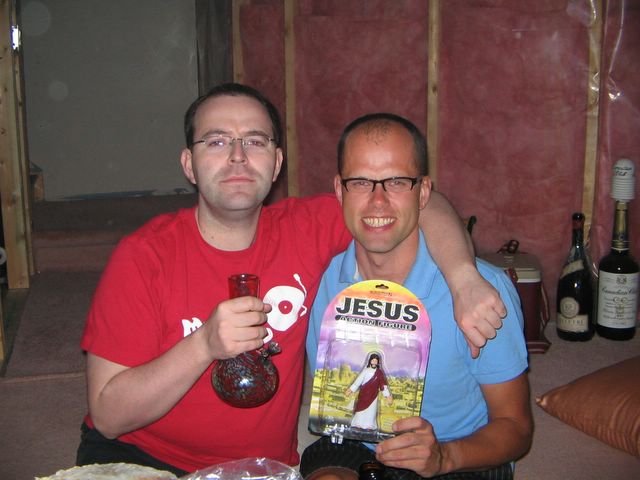
The three best things in the world...Joe, Juicy Fruit weed, and the Jesus Action Figure with REAL GLIDING ACTION! PRAISE THE LORD! HALLELUJAH!
Subscribe to:
Posts (Atom)